
White Sands National Park and its gypsum dunes
Published on 09/24/2026 at 10:34 | Editorial responsibility: Rafael Müller, Editor-in-Chief AD HOC NEWS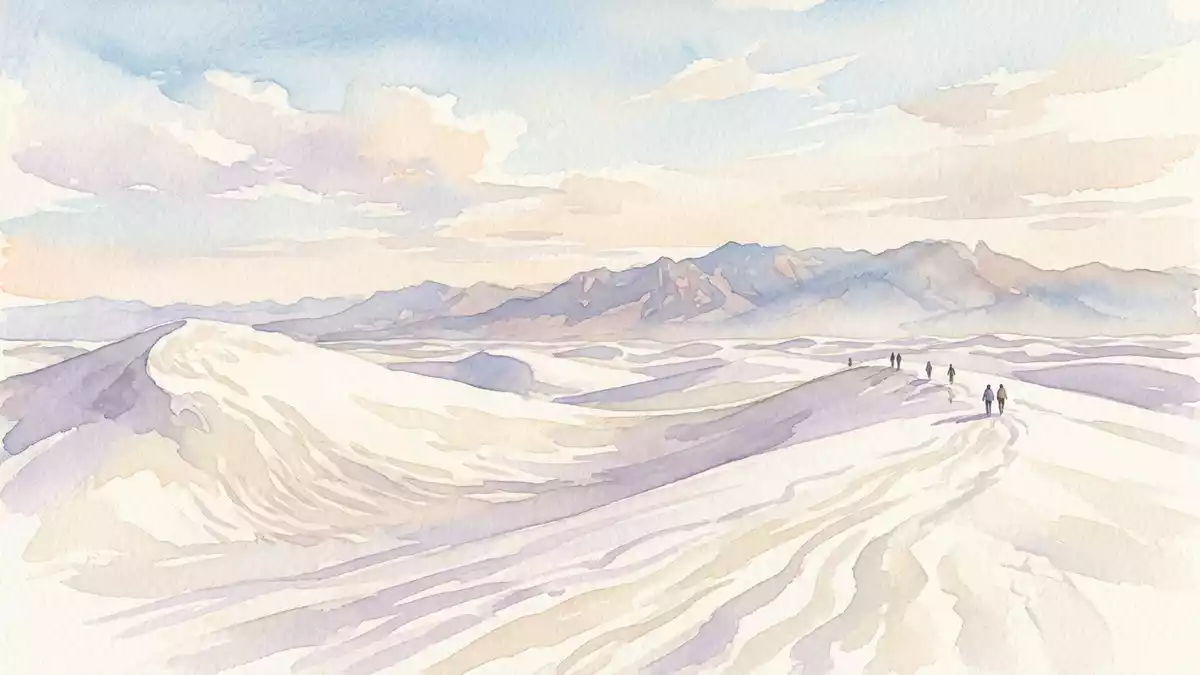
White Sands National Park occupies a broad stretch of the Tularosa Basin near Alamogordo, New Mexico. Its visible landscape is formed from white gypsum sand, arranged in long dunes that move across the desert and cover the ground like a continuous field of pale waves.
The park’s defining material is unusual in a landscape of dunes. Gypsum is common as a mineral, but it rarely survives as loose sand because water dissolves it. At White Sands, geology, water and wind have produced a landscape whose colour and texture remain closely connected to the mineral beneath the feet.
Gypsum sand across the Tularosa Basin
White Sands National Park protects part of a gypsum dunefield covering about 275 square miles. The protected landscape lies within the Chihuahuan Desert, in a closed basin between the San Andres and Sacramento mountains.
The gypsum originated in the Permian period, when shallow seas covered the region. Later geological changes lifted gypsum-bearing deposits, while rainwater carried dissolved material into the Tularosa Basin. The basin has no outlet to the sea, leaving minerals behind as water evaporated.
Wind breaks the resulting crystals into smaller grains and transports them across the basin. This process produces dunes with a soft, wave-like profile. The sand is made of gypsum crystals rather than the quartz grains found in many familiar desert landscapes. The mineral gives the dunes their pale appearance and their fine, powdery surface.
The dunes are not a single frozen landform. Wind reshapes ridges, slopes and hollows, while plants occupy parts of the field. The landscape therefore contains both moving sand and rooted vegetation, with plant life appearing in pockets across the white terrain.
From national monument to national park
President Herbert Hoover established White Sands National Monument on 18 January 1933 under the Antiquities Act of 1906. The protected area included the gypsum dunes and related natural features in the Tularosa Basin. White Sands history records the early conservation history and the change in designation.
Scientific interest in the dunes reaches back to research published in the nineteenth century. The gypsum field also contains evidence of human presence extending across thousands of years, including fossilised Ice Age footprints preserved in the basin.
On 20 December 2019, legislation changed the designation from national monument to national park. The change placed White Sands among the national parks of the United States while retaining its focus on gypsum geology, desert ecology and cultural history.
The park is also associated with the wider landscape of southern New Mexico. Military installations surround sections of the dunefield, and the basin contains a mixture of protected land, desert communities and transport routes. White Sands remains a landscape defined by the relationship between an enclosed basin and mineral-rich sand.
Walking among ridges, hollows and desert plants
The park’s dunes form a sequence of ridges and open hollows rather than a level expanse. Some areas show broad crests, while others contain steeper slopes where loose gypsum gathers against the side of a dune.
Plants growing in the sand include yucca and other desert species adapted to shifting ground. A plant may become surrounded by rising sand, leaving only its upper growth visible above a dune slope. Vegetation therefore appears as a clear contrast against the white surface.
Wildlife also occupies the dunefield. Animals living in the park include species adapted to the hot, dry conditions of the Tularosa Basin. Some have pale colouring associated with the white environment, while others use vegetation and dune hollows as habitat.
The park contains a scenic road leading from the visitor centre into the dunes. The route passes from desert scrub towards larger areas of gypsum sand, with marked walking routes and named locations along the drive. The changing relationship between plants and open dunes remains visible from the road and from the walking areas.
White Sands National Park is therefore both a desert landscape and a geological record. The white colour comes from gypsum, the dunes come from wind, and the basin preserves traces of water, animals and people. The same pale material links the park’s ancient origin with its visible form.
Visiting White Sands National Park: what travellers from Western Europe should know
- White Sands National Park lies west of Alamogordo on US Highway 70, between Alamogordo and Las Cruces. The entrance and visitor centre are reached directly from the highway.
- The terrain consists of loose gypsum sand, with dune slopes, soft hollows and exposed desert sections. Walking routes cross sand rather than paved ground.
- The park lies in the Tularosa Basin, where strong sun, dry air and open terrain are permanent features of the landscape. Water and sun protection form part of the physical demands of a walk.
- The official language is English and the currency is the US dollar.
- Entry requirements depend on your nationality; UK travellers can check the FCDO travel advice at gov.uk/foreign-travel-advice, Irish travellers the Department of Foreign Affairs at ireland.ie.
Searching for White Sands National Park on social platforms
These links open searches for White Sands National Park on each platform.
Frequently asked questions about White Sands National Park
Where is White Sands National Park?
White Sands National Park is in southern New Mexico, west of Alamogordo and between Alamogordo and Las Cruces. The park occupies part of the Tularosa Basin.
What can visitors expect from the landscape?
The landscape contains white gypsum dunes, loose sand, desert plants and open basin views. Walking routes cross ridges, slopes and hollows formed by wind-shaped sand.
What makes White Sands distinctive?
Its dunes are made from gypsum sand, a rare form of a common mineral. The park also combines a Permian geological origin with fossilised Ice Age footprints and a national park designation dating from 20 December 2019.


