
Yehliu Dizhi Gongyuan and its sculpted sandstone cape
Published on 09/22/2026 at 15:11 | Editorial responsibility: Rafael Müller, Editor-in-Chief AD HOC NEWS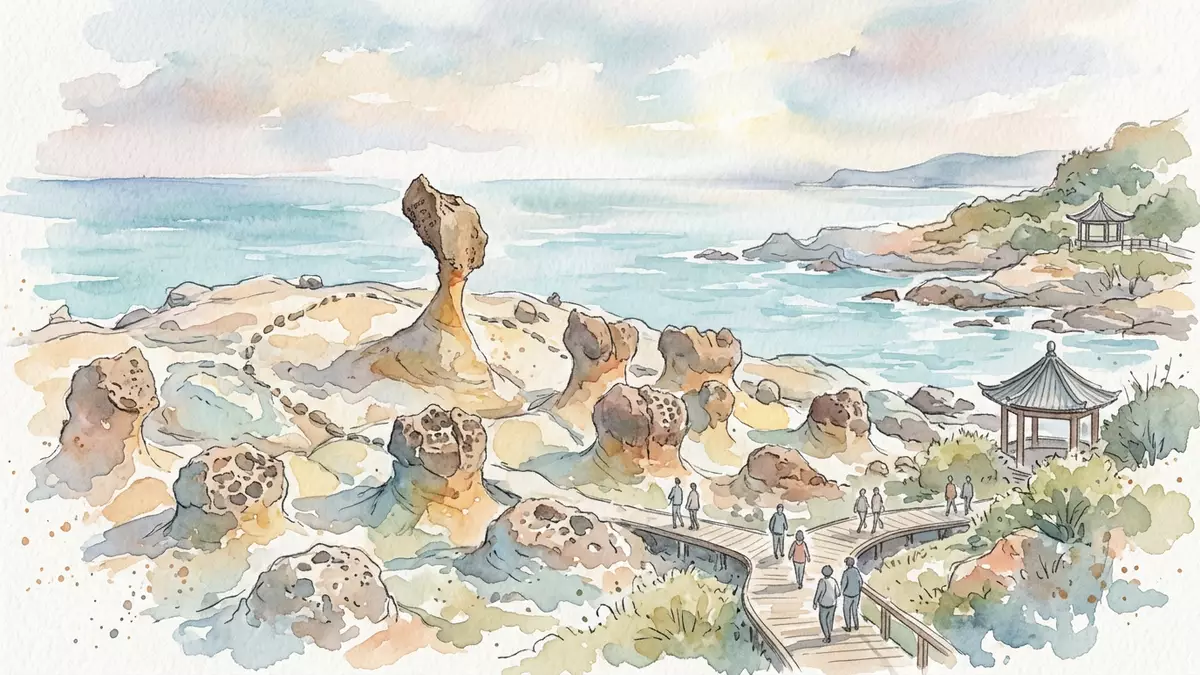
Yehliu Dizhi Gongyuan occupies a narrow headland on Taiwan’s north coast, where sandstone, limestone and shale meet the sea. The peninsula’s most recognisable formations include the Queen’s Head, mushroom rocks, sea trenches and caves. The result is a landscape read through rock surfaces rather than buildings.
Neu-Taipeh’s Yehliu Promontory extends about 1,700 metres into the sea. Its exposed strata belong to the Daliao Miocene Formation, giving the park a geological identity that reaches far beyond its celebrated profile-shaped rock.
The headland where the Daliao Formation meets the sea
Yehliu Dizhi Gongyuan lies in Wanli District, within Neu-Taipeh’s coastal landscape. The headland forms part of the Datun Mountain system and projects into the Taiwan Strait. From above, its long, tapering outline has been compared with a turtle entering the sea.
The underlying rocks include calcareous sandstone, shale and limestone. These layers were deposited during the Miocene, a geological period that began more than 23 million years ago and ended about 5.3 million years ago. Their visible surfaces contain ledges, hollows, grooves and raised blocks.
Sea erosion, wind weathering and movements in the Earth’s crust have produced the park’s varied forms. Softer layers have worn away around harder material, leaving mushroom rocks, candle-shaped stones, pot-shaped hollows and broad rock platforms. The formations remain part of an exposed coastal environment rather than a collection of carved monuments.
The park is divided into geological sections with different groups of named formations. The first section includes the Queen’s Head, Fairy’s Shoe and Candle. Bean Curd Rock and Dragon Head appear in another area, while sea-eroded caves and seal-shaped rocks occur farther along the cape. named formations at Yehliu
The Queen’s Head and the language of erosion
The Queen’s Head is a mushroom rock with a narrow sandstone column and a broader upper mass. Its outline resembles a side-facing human bust, which gave the formation its English name. The rock is not an isolated curiosity; it belongs to a wider field of hoodoos, honeycomb surfaces and weathered ledges.
Between 1962 and 1963, the upper concretion split and produced the profile associated with the Queen’s Head. This date gives the landmark a documented point in its visual history, while the surrounding rock records a much longer geological sequence. the Queen’s Head formation
The rock’s name refers to Queen Elizabeth, whose profile supplied the comparison. Its outline is created by weathered stone, not by a sculptor’s tool. The contrast between the slender neck and the heavier head makes the formation immediately legible from the viewing area.
Other rocks offer different visual vocabularies. Fairy’s Shoe has a compact, shoe-like outline, while Candle Rock rises in a tapered form. Tofu Rocks present pale, block-like masses, and honeycomb rocks carry dense pockets across their surfaces. The names create an informal map of the cape’s geology.
The Queen’s Head also demonstrates that the park’s forms are not fixed sculptures. Wind, rain, salt and wave action continue to act on exposed stone. The same processes that created the profile also alter the edges and textures of the surrounding formations. Yehliu’s named rock landscape
Fossils, cavities and a natural geological classroom
Yehliu Dizhi Gongyuan contains more than unusual silhouettes. Fossils and trace fossils appear in the Daliao Formation, linking the visible rocks with shallow marine life from the early Miocene. Sand-dollar sea urchins are among the fossils associated with the strata.
The fossil record includes Astriclypeus yeliuensis and Echinodiscus yeliuensis, two sea-urchin species associated with Taiwan. Other markings record the activity of animals that lived in shallow water. Small cavities in the rock preserve traces of feeding, shelter or movement.
These details are easiest to understand when the cape is viewed as a layered geological surface. The named formations attract attention through their outlines, while fossils reveal the older marine setting recorded inside the stone. Both belong to the same exposed strata.
The park’s three sections provide different views of coastal erosion. One area gathers recognisable mushroom rocks and named shapes. Another contains block-like formations. Farther along, caves, sea channels and cliff surfaces show the force of water on the cape’s edge.
Yehliu’s geological interest has also received formal protection. In December 2020, the site became a heritage geopark under Taiwan’s Cultural Heritage Preservation Act. heritage geopark status
The designation places the named rocks, strata and fossils within a broader cultural landscape. Yehliu Dizhi Gongyuan can therefore be read at several scales: as a coastal walk, a field of sculpted sandstone and a record of Miocene marine life.
Visiting Yehliu Dizhi Gongyuan: what travellers from Western Europe should know
- Yehliu Dizhi Gongyuan is in Wanli District, Neu-Taipeh, on Taiwan’s north coast. The site is reached by road and public buses serving Yehliu, including services from Keelung and Tamsui.
- The cape contains exposed rock platforms, uneven surfaces, sea channels and sections near cliffs. Walking routes pass named formations including the Queen’s Head, Fairy’s Shoe and Candle.
- The official language is Mandarin Chinese and the currency is the New Taiwan dollar.
Searching for Yehliu Dizhi Gongyuan on social platforms
These links open searches for Yehliu Dizhi Gongyuan on each platform.
Frequently asked questions about Yehliu Dizhi Gongyuan
Where is Yehliu Dizhi Gongyuan?
Yehliu Dizhi Gongyuan is on Yehliu Promontory in Wanli District, Neu-Taipeh, on Taiwan’s north coast. The cape projects into the sea from the Datun Mountain system.
What can visitors expect to see?
Visitors encounter exposed sandstone, shale and limestone, with rock platforms, caves, sea channels, mushroom rocks and named formations. The Queen’s Head, Fairy’s Shoe and Candle are among the most recognisable features.
What makes the park distinctive?
Its distinctive character comes from the combination of sculpted coastal rock and Miocene fossils. The Queen’s Head gives the landscape a memorable profile, while the strata preserve evidence of ancient marine life.


