
Yekaterininsky dvorets and its long Baroque façade in Puschkin
Published on 09/21/2026 at 14:08 | Editorial responsibility: Rafael Müller, Editor-in-Chief AD HOC NEWS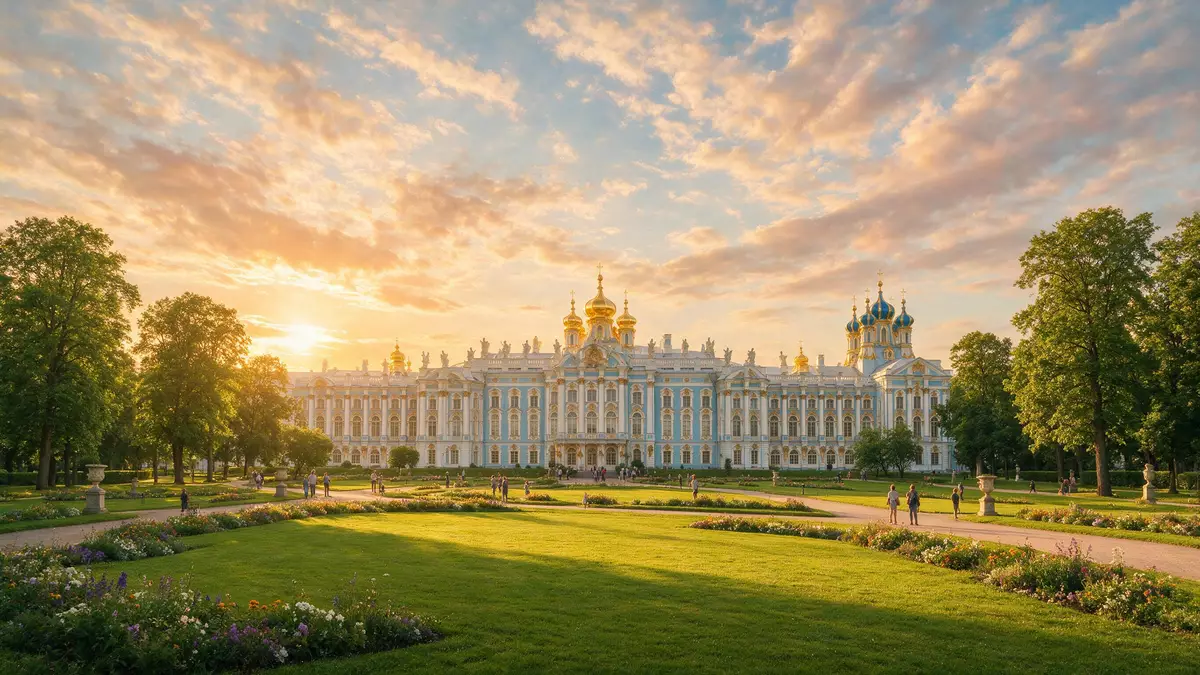
Yekaterininsky dvorets, known in English as the Catherine Palace, dominates the town of Puschkin near St Petersburg with an elongated Baroque façade facing its formal park. Built as a summer residence for the Russian imperial family in the eighteenth century, the palace forms part of the “Historic Centre of Saint Petersburg and Related Groups of Monuments” on the UNESCO World Heritage List, tying its gilded architecture to one of Russia’s most significant cultural landscapes.Catherine Palace in Tsarskoye Selo
A Rococo palace shaped by eighteenth-century court architects
The origins of Yekaterininsky dvorets lie in the early eighteenth century, when Empress Catherine I commissioned a masonry residence at Tsarskoye Selo around 1717, establishing the estate as a royal retreat south of the capital.Catherine I commissioned the palace The building that visitors recognise today is largely the work of Bartolomeo Francesco Rastrelli, the Italian-born architect of the Imperial Court, who rebuilt and enlarged the earlier residence in the Russian Baroque style in the 1750s for Empress Elizabeth, daughter of Peter the Great.Rastrelli’s mid-eighteenth-century reconstruction
Rastrelli’s design created a Rococo palace with a strongly horizontal emphasis, set within an ensemble of gardens and pavilions at Tsarskoye Selo, the imperial residence district that later took the name Puschkin.Katharinenpalast in Puschkin Subsequent rulers, including Catherine II (Catherine the Great), commissioned architects such as the Scotsman Charles Cameron to remodel interiors in classical and neoclassical styles, weaving newer decorative schemes into Rastrelli’s Baroque envelope while preserving the palace’s overall form.later embellishments under Catherine II
The long, gilded façade and grand enfilade of rooms
From the park side, Yekaterininsky dvorets presents an extensive frontage painted in shades of blue and white, punctuated by projecting bays and lined with columns and pilasters that carry gilded ornament. The length of the façade gives the palace a ribbon-like presence along the edge of the grounds, making its Rococo detailing visible from across the lawns and water features that form the wider Tsarskoye Selo landscape.Rococo exterior with gilded decoration
Behind this frontage lies an enfilade of state rooms arranged in sequence, reflecting eighteenth-century court ceremony and hospitality. These interiors include spaces where gilded mouldings, mirrors and painted panels line the walls, and others where later neoclassical work by designers like Charles Cameron introduces restrained stucco, classical motifs and fireplaces into the imperial apartments.Rococo and neoclassical interiors The palace’s scale, the richness of its sculptural decoration and the combination of Baroque and classical rooms make a walk through Yekaterininsky dvorets a concise survey of high-style Russian architecture in the later eighteenth century.
Tsarskoye Selo, Puschkin and the surrounding park
Yekaterininsky dvorets stands within the former imperial estate of Tsarskoye Selo, which has been incorporated into the town of Puschkin south of St Petersburg. The broader ensemble includes additional palaces, ornamental lakes, avenues and pavilions, forming a planned residence landscape that links court architecture to designed nature.Katharinenpalast and park at Tsarskoye Selo The town’s name, adopted in 1937 in honour of the poet Alexander Pushkin, underlines the site’s cultural associations as both a royal retreat and a place tied to Russian literature.Tsarskoye Selo renamed Puschkin
The park around the palace is laid out with straight and curved paths, stretches of lawn, canals and ornamental basins, and there are smaller buildings scattered through the grounds that once served as pavilions or auxiliary residences. As part of the World Heritage listing for Saint Petersburg and its related monuments, this landscape preserves the planning of an eighteenth-century imperial estate while forming a green district within the greater metropolitan area.World Heritage estate at Tsarskoye Selo
Visiting Yekaterininsky dvorets: what travellers from Western Europe should know
- Yekaterininsky dvorets stands in Puschkin, historically Tsarskoye Selo, a town south of St Petersburg reached from the city by suburban rail and road connections.
- The palace complex is set within extensive parkland, and a visit involves walking across level paths and through long interior corridors and staircases.
- The official language is Russian and the currency is the rouble.
- Entry requirements depend on your nationality; UK travellers can check the FCDO travel advice at gov.uk/foreign-travel-advice, Irish travellers the Department of Foreign Affairs at ireland.ie.
Searching for Yekaterininsky dvorets on social platforms
These links open searches for Yekaterininsky dvorets on each platform.
Frequently asked questions about Yekaterininsky dvorets
Where is Yekaterininsky dvorets located?
Yekaterininsky dvorets stands in the town of Puschkin, historically Tsarskoye Selo, to the south of St Petersburg in Russia, within a former imperial estate.
What can visitors expect on a visit to the palace?
Visitors encounter a long Rococo façade with gilded decoration, formal parkland and a sequence of grand state rooms, some retaining Baroque interiors and others showing neoclassical remodelling.
What makes Yekaterininsky dvorets distinctive among Russian palaces?
The palace’s combination of an extended Baroque frontage, richly sculpted exterior, historically layered interiors and its setting in the Tsarskoye Selo park makes it a central monument of eighteenth-century Russian court architecture.


