

Yokohama Chukagai and its dense temple gates
Published on 08/10/2026 at 15:05 | Editorial responsibility: Rafael Müller, Editor-in-Chief AD HOC NEWS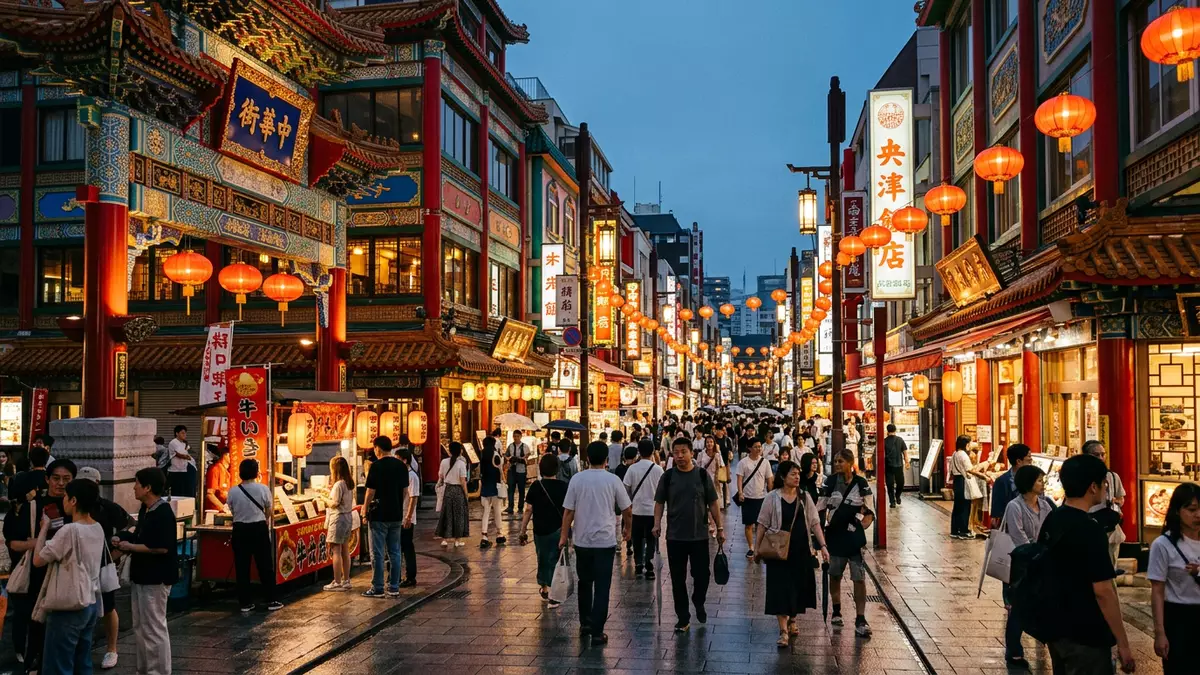
Yokohama Chukagai is Yokohama’s Chinatown, a dense district of bright gates, narrow streets and restaurant fronts. Its modern form grew after Chinese merchants settled in Yokohama after the port opened in 1859, and the area still centres on food, worship and commerce.
Gates, colour and a tightly packed street grid
The district is entered through painted gates and lined with multicoloured facades, lanterns and signboards in Chinese and Japanese. Streets run close together, with temples and shops sharing the same blocks.
The strongest impression comes from the layering of uses. A visitor can move from a commercial street into a temple courtyard, then back into lanes filled with noodle shops, bakeries and souvenir counters.
Chinese temples and everyday trade
Two landmarks anchor the district’s religious life: Kanteibyo, dedicated to Guan Yu, and Masobyo, associated with Mazu. Their carved details, incense and ornament give the quarter a ceremonial core within the retail streets.
Restaurants dominate much of the ground level, and the district is known for Chinese regional cooking adapted for local tastes as well as more formal banquet dining. The result is a place where daily trade and ritual coexist in the same compact urban fabric.
A port city district with a long immigrant history
Yokohama Chukagai reflects the history of Yokohama as one of Japan’s major international port cities. Chinese residents established businesses here after the foreign settlement period, and the neighbourhood developed as a commercial and residential district tied to the port.
The streets also show how the area changed across the late nineteenth and twentieth centuries, with rebuilding and renewal producing the present street pattern and ornamental architecture. The district therefore reads less like a single monument than like a layered urban quarter shaped by migration, religion and trade.
Visiting Yokohama Chukagai: what travellers from Western Europe should know
- The district is in central Yokohama and is reached by train and on foot from nearby stations.
- Admission arrangements and opening hours are set by the site's operator and change with the season; the official website is the only binding source.
- Evening brings bright lighting and a lively restaurant scene, while daytime is better for seeing temple details and street decoration.
- The streets are flat, paved and crowded in places, so comfortable walking shoes are sensible.
- Japanese is the main language on site, though menus and signs often include some Chinese and English; cash and cards are both useful.
- Entry requirements depend on your nationality. UK travellers should check the FCDO travel advice at gov.uk/foreign-travel-advice; Irish travellers the Department of Foreign Affairs at ireland.ie; EU and EEA citizens their own national foreign ministry.
Searching for Yokohama Chukagai on social platforms
These links open searches for Yokohama Chukagai on each platform.
Frequently asked questions about Yokohama Chukagai
Where is Yokohama Chukagai?
It is Yokohama’s Chinatown, in the city centre near the port and accessible by train and on foot. The district sits within a compact urban area rather than a separate suburb.
What should visitors expect?
Expect a busy street district with restaurants, temple gates, decorated facades and short walking distances between blocks. Food is a major draw, but the temples give the quarter a broader character.
What makes it distinctive?
Its mix of Chinese temples, restaurant streets and port-city history gives it a layered identity. Kanteibyo and Masobyo add a religious centre to a district best known for eating and shopping.


