
Yungang Shiku and its cliff of carved Buddhas near Datong
Published on 09/02/2026 at 16:33 | Editorial responsibility: Rafael Müller, Editor-in-Chief AD HOC NEWS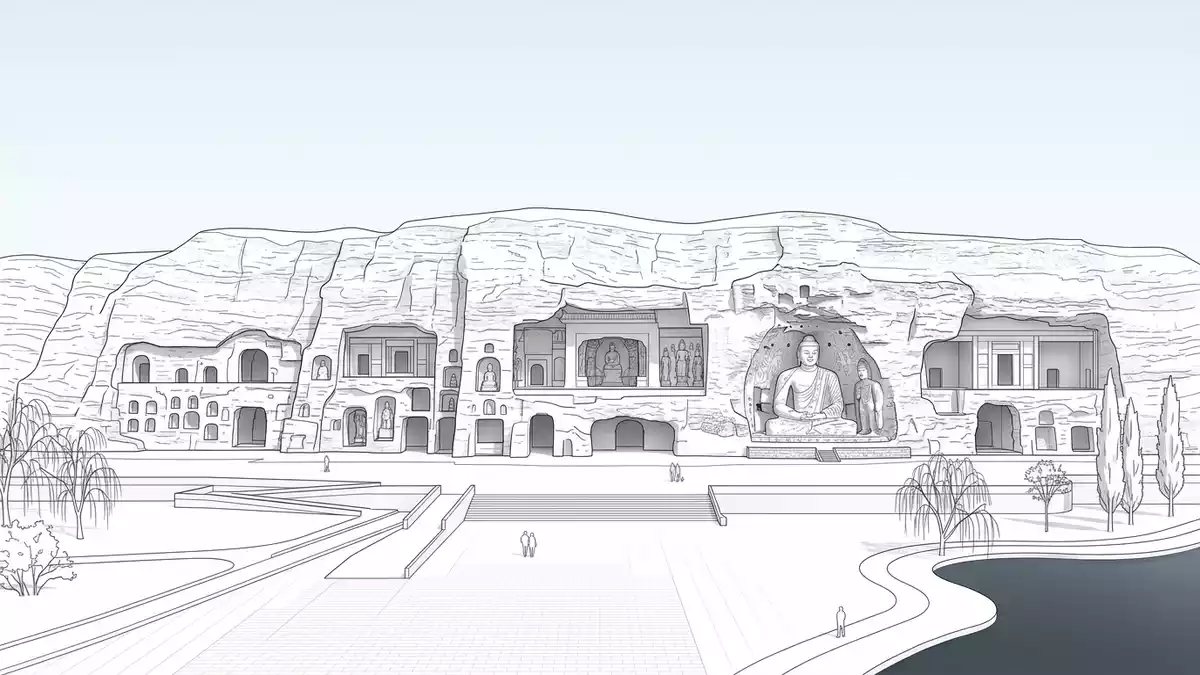
On the sandstone cliffs west of Datong in northern China, Yungang Shiku presents a continuous wall of Buddhist caves carved in the fifth and sixth centuries into the foot of the Wuzhou Mountains. The grottoes date to the Northern Wei dynasty and form a major ensemble of early Buddhist cave art along the Shi Li River valley.
A Northern Wei cliff turned into a stone monastery
Yungang Shiku, known internationally as the Yungang Grottoes, was cut into a sandstone escarpment at the southern foot of the Wuzhou Mountains, around 16 km west of Datong in Shanxi Province.southern foot of the Wuzhou Mountains In the fifth century this area lay close to the Northern Wei capital of Pingcheng, the earlier name for Datong, and imperial patrons turned the cliff into a rock-cut monastery rather than a freestanding complex of halls.
The core phase of construction belongs to the fifth and sixth centuries, under Northern Wei rulers who adopted Buddhism and expressed it in a sequence of shrines carved directly into the rock.Northern Wei Buddhist cave art The total carved area extends for about 1 km (0.62 miles) from east to west along the cliff, with caves and niches opening out of the vertical face and forming a continuous band of sculpted stone.extends about 1 km from east to west
Caves, statues and the Tan Yao Five
What strikes visitors first at Yungang Shiku is the sheer quantity of carving: hundreds of caves and niches and tens of thousands of figures occupy almost every available surface of the sandstone wall.252 caves and 51,000 statues Larger caves contain monumental Buddhas surrounded by bodhisattvas and guardians, while smaller cells are lined with bands of seated figures, miniature pagodas and narrative reliefs of Buddhist stories.
Among these, one group has a special status. Five early caves on the western side, known collectively as the Tan Yao Five, were created under the monk Tan Yao and show a unified layout with a single principal Buddha in each shrine.Five Caves created by Tan Yao These caves date to the first peak of Northern Wei sculpture in the mid-fifth century and are closely associated with imperial patronage under Emperor Wencheng.early phase centred on Tan Yao
UNESCO World Heritage and artistic fusion
Yungang Shiku is inscribed as a UNESCO World Heritage Site for its role as a masterpiece of early Chinese Buddhist cave art and for the way its sculptures fuse influences from South and Central Asia with Chinese traditions.UNESCO World Heritage inscription The sandstone cliff carries caves and niches across an area of about 18,000 square metres, with figures ranging from small reliefs to giant seated Buddhas carved almost free from the rock.
Stylistically, the statues at Yungang Shiku reflect this fusion. Some figures show drapery and bodily proportions linked to Gandhara and other regions, while later caves combine that legacy with more sinicised forms associated with the Northern Wei period.Gandhara influence and Chinese art Across the site, carved roofs, pillars, altars and image walls contribute to the impression of a stone monastery built into the mountain rather than a single temple building.
Visiting Yungang Shiku: what travellers from Western Europe should know
- Yungang Shiku lies to the west of Datong, at the southern foot of the Wuzhou Mountains along the Shi Li River valley, and is reached by road from Datong City.
- The grottoes occupy a sandstone cliff, and visiting the main caves involves walking along outdoor paths and climbing flights of stone steps between different terrace levels.
- The site stands in Shanxi Province in northern China; the official language is Chinese and the currency is the renminbi (yuan).
- Entry requirements depend on your nationality; UK travellers can check the FCDO travel advice at gov.uk/foreign-travel-advice, Irish travellers the Department of Foreign Affairs at ireland.ie.
Searching for Yungang Shiku on social platforms
These links open searches for Yungang Shiku on each platform.Frequently asked questions about Yungang Shiku
Where is Yungang Shiku located?
Yungang Shiku stands on a sandstone cliff at the southern foot of the Wuzhou Mountains, west of Datong in Shanxi Province in northern China.
What can visitors expect when exploring the grottoes?
Visitors encounter a line of caves cut into the cliff, with monumental Buddhas, carved image walls and thousands of smaller figures arranged across terraces and stone stairways.
What makes Yungang Shiku distinctive among Buddhist sites?
Its long cliff of caves, vast number of sculptures and fifth- to sixth-century fusion of foreign and Chinese styles give Yungang Shiku a distinctive character among Buddhist grotto complexes.


