
Yungang Shiku: cliffside Buddhas on a sandstone river valley
Published on 09/18/2026 at 10:40 | Editorial responsibility: Rafael Müller, Editor-in-Chief AD HOC NEWS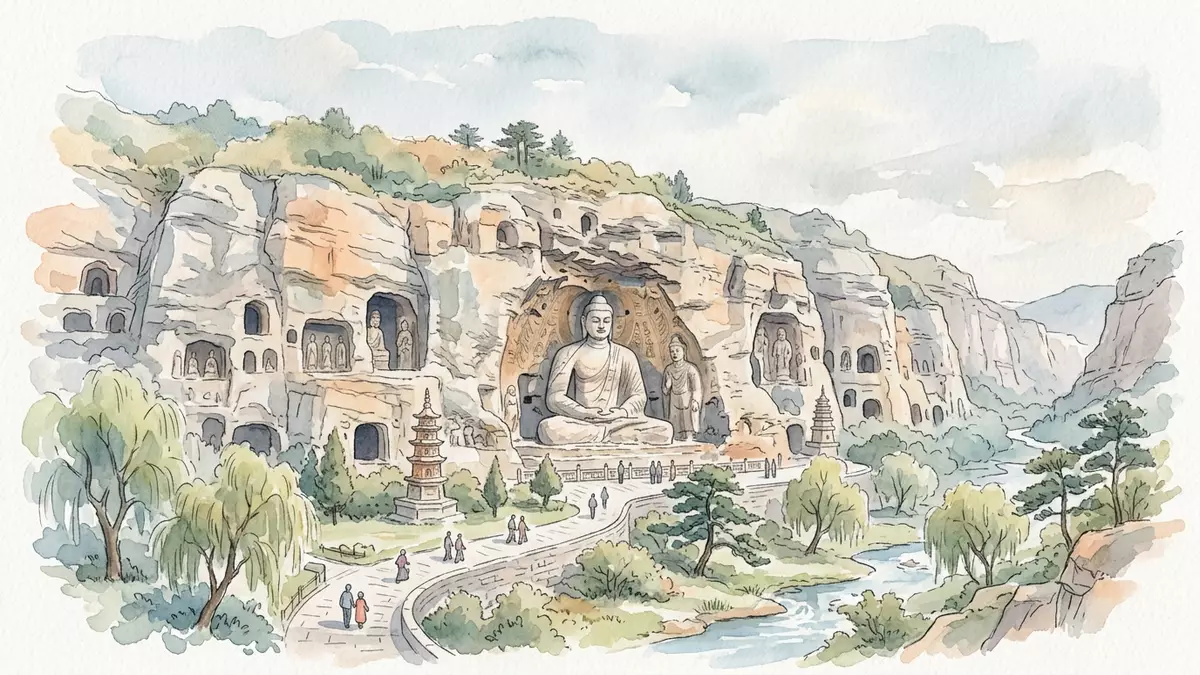
Yungang Shiku, known in English as the Yungang Grottoes, is a vast complex of Buddhist cave temples carved into sandstone cliffs west of Datong in northern China’s Shanxi Province. Created under the Northern Wei dynasty in the fifth and early sixth centuries, the caves line the southern foot of the Wuzhou Mountains along the Shi Li River valley, turning an exposed rock face into a continuous relief of Buddhas, bodhisattvas and decorative carving.
A Buddhist cliff turned into stone architecture
The defining experience at Yungang Shiku is the encounter with an entire cliff transformed into a carved religious landscape. The grottoes are cut into the south face of a sandstone escarpment stretching for about one kilometre from east to west, with cave fronts, niches and sculpted façades following the line of the rock.Yungang Grottoes were built against the mountain and extend about 1 km Visitors step from open air into chambers whose walls and ceilings are covered by carved figures and painted ornament, many laid out to imitate timber architecture with pillars, beams and bracket sets rendered in stone.Many cave interiors were designed to imitate wooden architecture
The site is usually divided into western, central and eastern sectors, each corresponding to different phases of carving under Northern Wei patronage.The complex is commonly structured into three sectors In the western part, some caves preserve early colossal images cut directly into the rock face, while central and eastern caves display more intricate interior layouts with multiple tiers of sculpture and denser decorative programmes. Walking along the cliff reveals this progression in style and complexity, with cave entrances opening onto different spatial arrangements but sharing the same sandstone substrate.
Northern Wei patronage and the carving of the caves
The history of Yungang Shiku is closely tied to the Northern Wei dynasty, which ruled parts of northern China from the late fourth to the early sixth century. Construction of the caves is traditionally dated to around 460 CE under Emperor Wencheng, and work continued into the early sixth century, spanning several reigns and roughly six decades of activity.Historical records indicate construction commenced around 460 AD and continued until about 524 AD The monk Tan Yao is recorded in Northern Wei histories as playing a decisive role in initiating the earliest major caves and advising imperial sponsors.Tan Yao is named as a key figure in starting the project
Yungang Shiku forms part of a wider group of major Buddhist cave complexes in China, alongside sites such as the Longmen, Maiji and Mogao grottoes, and represents an early moment in the adaptation of Indian and Central Asian Buddhist imagery to Chinese artistic conventions.The Yungang Grottoes are recognised among the four most significant grotto complexes in China In 2001, the caves were inscribed as a UNESCO World Heritage Site, recognised for their outstanding achievement in Buddhist cave art and the fusion of imported iconography with local cultural forms.UNESCO listed the Yungang Grottoes in 2001 under cultural criteria i, ii, iii and iv
Faces, figures and the scale of the sculptures
Within the carved area, Yungang Shiku contains hundreds of caves and niches, with tens of thousands of statues ranging from monumental seated Buddhas to thumb-sized figures embedded in decorative bands. UNESCO describes the complex as comprising 252 caves and niches and around 51,000 statues within a carved area of about 18,000 square metres.The World Heritage listing cites 252 caves and 51,000 statues Other detailed surveys record 45 major caves and more than 250 altar cavities of varying sizes along the cliff, demonstrating the density of work along a relatively short stretch of rock.Scholarly surveys describe 45 major caves and over 250 smaller cavities
Carved imagery includes seated and standing Buddhas, bodhisattvas, guardians, apsaras and donors, often arrayed in tiers on cave walls or grouped around central pillars. In some chambers, a square plan encloses a central pillar carved with images, adapting sanctuary types seen elsewhere in Buddhist architecture.Analyses of Cave 6 describe a square plan with a central pillar Surviving traces of colour in places hint at the painted surfaces that once covered many figures and architectural motifs, while exterior façades show reliefs carved around cave entrances, integrating sculpture and cliff face into a single composition.
Visiting Yungang Shiku: what travellers from Western Europe should know
- Yungang Shiku lies on the southern foot of the Wuzhou Mountains beside the Shi Li River valley, about 16 km (10 mi) west of central Datong in Shanxi Province, reached by road from the city.
The cliffside caves run for roughly one kilometre along a sandstone escarpment. - The caves are cut into a natural cliff, and visiting involves walking along outdoor paths and entering chambers where floors, steps and rock surfaces can be uneven.
- Datong experiences marked continental seasons, with cold winters and warm summers, so conditions on the exposed cliff and in the open courtyards reflect the wider climate of northern Shanxi.
- The official language is Chinese and the currency is the renminbi (yuan).
- Entry requirements depend on your nationality; UK travellers can check the FCDO travel advice at gov.uk/foreign-travel-advice, Irish travellers the Department of Foreign Affairs at ireland.ie.
Searching for Yungang Shiku on social platforms
These links open searches for Yungang Shiku on each platform.
Frequently asked questions about Yungang Shiku
Where is Yungang Shiku located?
Yungang Shiku is situated on the southern foot of the Wuzhou Mountains beside the Shi Li River valley, west of Datong in Shanxi Province in northern China.
What can visitors expect on a visit?
Visitors walk along a sandstone cliff lined with cave entrances, stepping into carved chambers where walls, ceilings and pillars are covered in Buddhist figures and architectural motifs.
What makes Yungang Shiku distinctive among Buddhist sites?
The complex combines hundreds of caves, tens of thousands of statues and interiors that imitate timber architecture, created under Northern Wei imperial patronage and recognised as a UNESCO World Heritage Site.


