
Yuyuan Garden in Shanghai’s old city labyrinth
Published on 09/16/2026 at 22:24 | Editorial responsibility: Rafael Müller, Editor-in-Chief AD HOC NEWS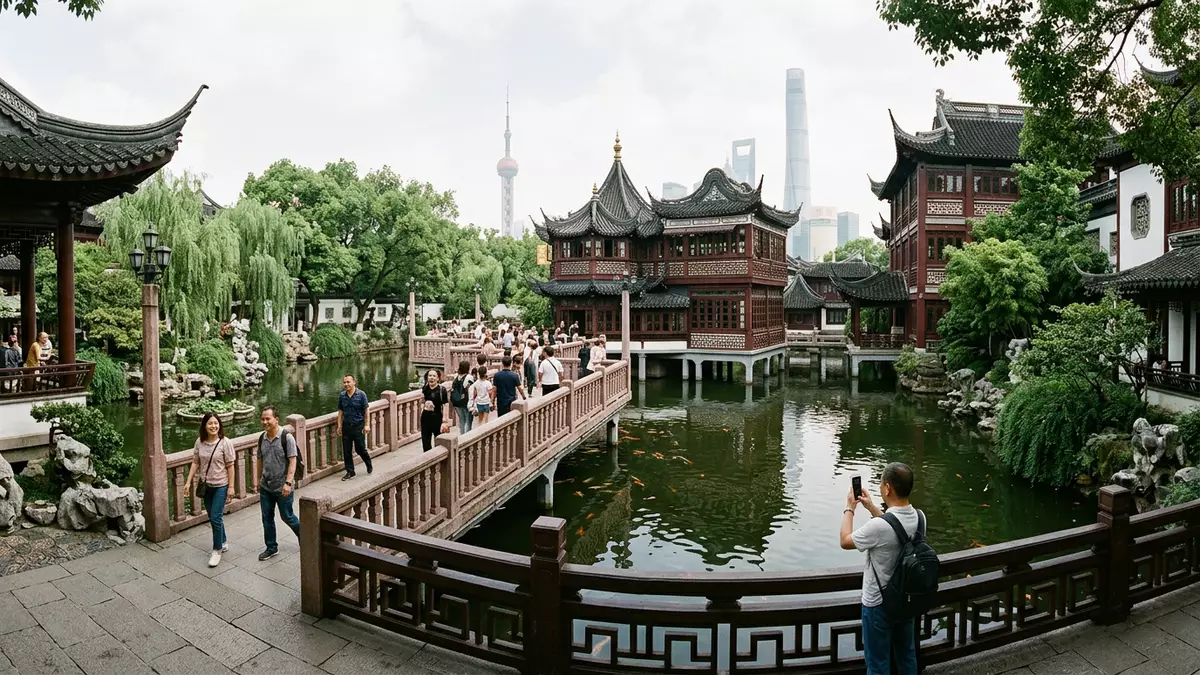
Yuyuan in Shanghai, often known in English as Yu Garden or Yuyuan Garden, is a classical Chinese garden laid out during the Ming dynasty and preserved within the city’s old urban fabric. Created in the sixteenth century as the private retreat of the official Pan Yunduan, it condenses traditional Jiangnan garden design into a compact walled world of halls, rock formations and water. Today it sits beside the City God Temple and the surrounding bazaar district, making it one of the most distinctive juxtapositions of historic garden and commercial streets in Shanghai.
A classical garden tucked inside Shanghai’s Old City
Yuyuan occupies part of the Old City of Shanghai in Huangpu District, close to the former walled core and not far from the Bund on the Huangpu River. Described as an extensive traditional Chinese garden beside the City God Temple, it lies within walking distance of the Yuyuan Tourist Mart, the Huxinting Teahouse and the busy Yu Garden bazaar.an extensive Chinese garden Within its boundary walls the garden covers roughly two hectares, a modest footprint that feels larger because of the way pavilions, courtyards and ponds are layered and partitioned.more than 30 mu
The garden dates to the Jiajing reign of the Ming dynasty, beginning around 1559 and developing over many years as Pan Yunduan’s family estate.built in 1559 as the private garden of Pan Yunduan Its name, translated as “Garden of Happiness” or “Garden of Peace and Comfort”, hints at its original role as a place of contentment within a turbulent commercial city.Yu Garden, aka Yuyuan Garden Over the centuries Yuyuan has been damaged and restored multiple times through conflict and neglect, yet its character as a Ming?era scholar’s garden with intricate structures and planting remains legible.
Rockeries, halls and water: the compressed landscape of Yuyuan
Within the walls Yuyuan is divided into named scenic areas, each with its own arrangement of buildings, ponds and rock formations. Six main sections are often distinguished: Sansui Hall, Wanhua Chamber, Dianchun Hall, Huijing Hall, Yuhua Hall and the Inner Garden.six main scenic areas Together they demonstrate the principles of classical southern Chinese garden design, where constructed “mountains”, zigzagging walkways and framed views turn a limited urban plot into a layered landscape. Visitors move between enclosed courtyards, timber halls and waterside terraces, with walls and corridors constantly reconfiguring sightlines.
Rockeries are central to the effect, rising in jagged stacks that evoke distant peaks but are pieced together with carefully chosen stone. Ponds, planted with lotus or edged by galleries, reflect pavilions and bridges, while ornamental walls carry tiled ridges in the form of dragons. Halls such as Sansui and Yuhua show timber architecture from the Ming period, with upturned roof corners and carved details that contrast with the rough stone of the rockeries.a classical southern style Chinese garden The Inner Garden, occupying a portion of the overall site, tightens these elements into a more intimate composition of small structures and water.
A garden shaped by dynasties, war and restoration
Yuyuan’s history reflects Shanghai’s broader shifts from Ming mercantile town to treaty port and modern metropolis. Construction began in the late sixteenth century under Pan Yunduan, a Ming official, and continued intermittently for years, eventually exhausting much of the Pan family’s resources.Pan Yunduan decided to build the Yu Gardens in 1559 Later, during the Qing dynasty, wealthy merchants purchased and rebuilt parts of the grounds, and the garden became associated with the City God Temple precinct.
Conflict left deep marks on the site. The Opium War in the nineteenth century and uprisings such as the Small Sword Society rebellion caused severe damage, with pavilions and plantings destroyed or repurposed.repeatedly destroyed, and has been rebuilt several times In the twentieth century further harm came during the Japanese occupation. After the establishment of the People’s Republic of China in 1949, Yuyuan received official protection, and a major restoration campaign began in 1956, leading to the reopening of the garden to the public in 1961.officially opened to the outside world in 1961 The garden has since been recognised as a national historical site and continues to undergo careful maintenance.
Visiting Yuyuan: what travellers from Western Europe should know
- Yuyuan stands in Huangpu District in Shanghai’s Old City, close to the City God Temple precinct and within the streets around Anren Street and Fuyou Road.
- The garden interior includes numerous stone steps, uneven rockery paths and narrow corridors; moving through the different halls and courtyards involves frequent changes of level.
- Shanghai Metro Line 10 and Line 14 both serve Yuyuan Garden station, giving direct rail access from other parts of the city.
- The surrounding blocks form a dense bazaar and shopping area with teahouses and small lanes, so the immediate approach is through busy pedestrian streets rather than open parkland.
- The official language is Chinese and the currency is the renminbi (yuan).
Searching for Yuyuan on social platforms
These links open searches for Yuyuan on each platform.Frequently asked questions about Yuyuan
Where is Yuyuan located in Shanghai?
Yuyuan is in Huangpu District, within Shanghai’s Old City, beside the City God Temple and near the streets Anren Street and Fuyou Road.
What can visitors expect inside Yuyuan?
Visitors encounter a sequence of Ming?dynasty halls, rockeries, ponds and enclosed courtyards arranged into several scenic areas, with traditional architecture and planting throughout.
What makes Yuyuan distinctive among Shanghai’s sights?
Yuyuan stands out for compressing a sixteenth?century classical garden into a small inner?city plot, surrounded by teahouses and bazaars yet retaining its historic layout.


