
Zamek Krolewski na Wawelu: Poland’s layered royal citadel
Published on 09/19/2026 at 06:26 | Editorial responsibility: Rafael Müller, Editor-in-Chief AD HOC NEWS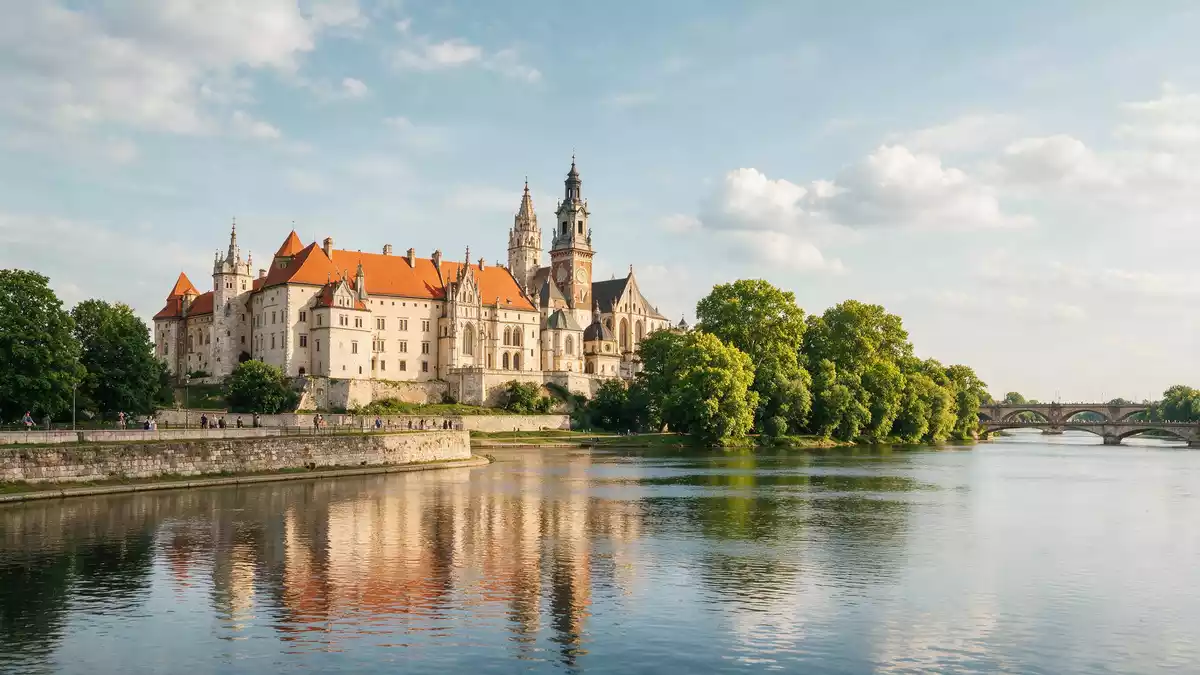
Zamek Krolewski na Wawelu, the Wawel Royal Castle in Krakau, rises on a limestone hill above a bend of the Vistula River, combining medieval fortifications with Renaissance state rooms at the heart of Polish history.
A royal stronghold shaped across centuries
The Wawel hill has held fortified stone buildings since the early Middle Ages, forming an early seat of secular and ecclesiastical power in what became the Polish state.seat of secular and ecclesiastical power Archaeological and written evidence links the site to the first Piast rulers, including Mieszko I, who ruled between 960 and 992 and used Wawel as one of his residences.Mieszko I
The core of the present castle dates to the thirteenth and fourteenth centuries, when a stone Gothic residence was raised above earlier defences and extended under King Casimir III the Great.built in the 13th and 14th centuries In the late medieval period and through the fifteenth century, Wawel served as the principal royal residence, with the hill functioning as the political centre of the kingdom and the neighbouring cathedral providing a setting for coronations and royal burials.seat of rulers from the Piast and Jagiellonian dynasties
Renaissance courtyard and layered architecture
Between the early sixteenth century and the reigns of Aleksander Jagiello?czyk, Sigismund I the Old and Sigismund II Augustus, the castle was rebuilt from a tight Gothic complex into a Renaissance palace around an arcaded courtyard.Renaissance palace around an arcaded courtyard Italian architects such as Francesco Fiorentino and Bartolomeo Berrecci introduced regular facades, arcades and classical detailing, giving Wawel one of the most prominent Renaissance residences in central Europe.Italian Renaissance architects
The hill today carries a mix of architectural styles, including Romanesque remains, Gothic walls and towers, Renaissance palace wings and Baroque additions, reflecting successive dynasties and restoration campaigns.Romanesque, Gothic, Renaissance and Baroque Visitors move between defensive elements such as thick curtain walls and bastions, residential ranges built around the main courtyard, and religious structures led by Wawel Cathedral, whose Gothic body is complemented by later chapels and domes.
From royal residence to national museum
Wawel remained closely tied to Polish monarchy from the eleventh century through to the seventeenth century, housing kings from the Piast and Jagiellonian dynasties and the first elected rulers.seat of rulers and elected kings Even after the political centre moved to Warsaw, the cathedral on the hill continued to host coronations and royal funerals, reinforcing Wawel’s role in state ceremony.coronations and funerals
Following the partitions of Poland, the castle complex was taken over by Austrian authorities in 1796 and used as military barracks, a role that left its structures in need of substantial restoration by the early twentieth century.taken over by Austrian authorities in 1796 A major programme of conservation and reconstruction established Wawel as a museum, and since 1930 the castle has functioned as one of Poland’s principal museum institutions, displaying collections of paintings, textiles, armour, furnishings and state regalia in its historic rooms.became a museum in 1930
Visiting Zamek Krolewski na Wawelu: what travellers from Western Europe should know
- Zamek Krolewski na Wawelu stands on Wawel hill on the southern edge of Krakau’s historic centre, above the Vistula; Krakow G?ówny station lies north of the complex.
- The approach from the riverside and the old town involves an uphill walk on paved paths and courtyards, with sections of cobbles and stairways inside the defensive walls.
- Wawel Cathedral and the castle courtyards sit within the same enclosed complex, so moving between religious and secular buildings involves passing through gates in the fortifications.
- The official language is Polish and the currency is the Polish zloty.
- Entry requirements depend on your nationality; UK travellers can check the FCDO travel advice at gov.uk/foreign-travel-advice, Irish travellers the Department of Foreign Affairs at ireland.ie.
Searching for Zamek Krolewski na Wawelu on social platforms
These links open searches for Zamek Krolewski na Wawelu on each platform.
Frequently asked questions about Zamek Krolewski na Wawelu
Where is Zamek Krolewski na Wawelu located?
Zamek Krolewski na Wawelu stands on Wawel hill on the southern side of Krakau’s old town, above a curve of the Vistula River.
What can visitors expect on a visit to Wawel?
Visitors encounter fortified walls, courtyards framed by Renaissance arcades, royal chambers, and the neighbouring cathedral with its Gothic core and later chapels.
What makes Zamek Krolewski na Wawelu distinctive?
The combination of medieval fortifications, a sixteenth-century Renaissance palace and its long role as the seat of Polish kings gives Wawel an unusually layered character.


