
Zamek w Malborku and the brick power of the Teutonic Order
Published on 08/15/2026 at 14:38 | Editorial responsibility: Rafael Müller, Editor-in-Chief AD HOC NEWS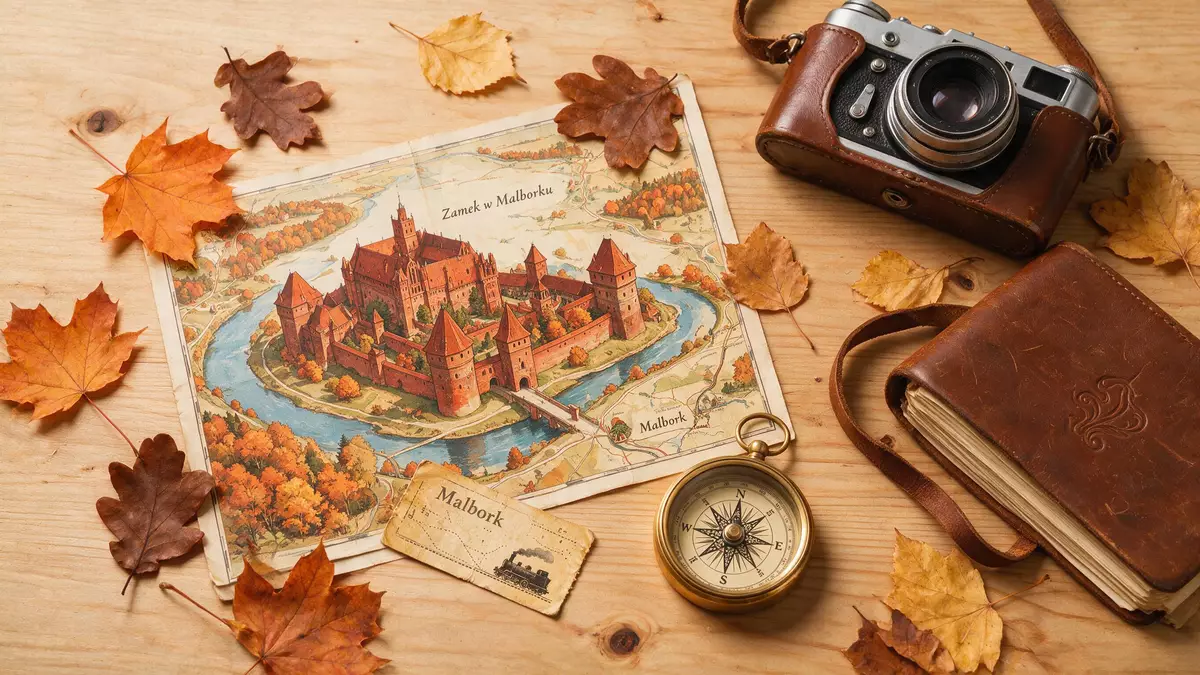
Zamek w Malborku, known in English as Malbork Castle, rises above the river Nogat as a sprawling Brick Gothic fortress that once anchored the power of the Teutonic Order in northern Poland. Built from the late thirteenth century and expanded in the fourteenth century, it became the seat of the Grand Masters and later a royal residence, and its sheer brick mass still dominates the town of Malbork.
A brick-built stronghold on the Nogat
Malbork Castle stands on the right bank of the Nogat, a branch of the Vistula delta that flows towards the Baltic Sea in northern Poland. The town of Malbork lies inland from the coast, with the castle complex set slightly above the river on low-lying ground, its walls and towers running parallel to the water.Malbork Castle stands on the banks of the Nogat River The setting links the fortress to waterborne routes across Pomerania, yet the immediate surroundings feel dominated by brick rather than by shoreline.
The castle is built almost entirely of brick, a hallmark of the Teutonic Order’s architecture in eastern Europe and one reason the complex is regarded as a textbook example of medieval defensive and residential design.Malbork Castle is described as a supreme example of medieval brick castle architecture From the outside, long curtain walls and rectangular towers form a continuous envelope of reddish masonry, punctuated by steeply pitched roofs and narrow openings. Inside, the same material shapes arcades, vaulted halls and cloisters, so that brick is not only a structural choice but also the surface visitors see at every turn.
From Teutonic monastery to museum complex
Construction at Malbork began in the thirteenth century as a fortified monastery for the Teutonic Knights, a crusading military order operating in Prussia and the Baltic region.The Castle of the Teutonic Order in Malbork was built in the 13th century and enlarged in the 14th In 1309, after the Grand Master moved his seat from Venice to Malbork, the complex became the capital of Teutonic Prussia and the centre of a monastic state that projected its power through both warfare and administration.The Knights Fortress was substantially enlarged after 1309 when the Grand Master moved here Over the following decades, the castle was extended and reinforced until it reached a mature form in the early fifteenth century.
After the Teutonic Order’s defeat at the Battle of Grunwald in 1410 and later political changes, Malbork Castle shifted from monastic capital to royal residence. From 1457 it served the kings of Poland and became an administrative centre for Royal Prussia, embedding the fortress in a new political framework while keeping its defensive fabric largely intact.Malbork became the residence of the kings of Poland from 1457 In the eighteenth and nineteenth centuries the building fell into disrepair, a period which later gave way to ambitious restoration campaigns that sought to recover its medieval appearance. Twentieth-century damage, including destruction in 1945, triggered further reconstruction, and in 1961 the Castle Museum in Malbork was founded as the institution that manages the site today.A Castle Museum was founded in 1961 and restoration resumed
Three castles within one fortress
One of the most striking aspects of Zamek w Malborku is its internal division into three linked castles: the High Castle, the Middle Castle and the Lower Castle. Together they occupy a land area that makes Malbork the largest castle complex in the world when measured by surface.Malbork Castle is the largest castle in the world measured by land area The High Castle, laid out as a conventual house, presents a quadrangular plan with a central courtyard framed by tall brick ranges. The Middle Castle contains representative spaces such as the Grand Master’s Palace, while the Lower Castle holds outer bailey structures that once supported the everyday running of the complex.
Walking through the precincts brings the layered organisation into view. Gatehouses lead into successive wards, each defended by moats, walls and towers, and each with its own role in the medieval hierarchy of the Order. Within the High Castle, cloisters connect residential ranges and chapels, and large halls display the brick vaulting typical of the region’s Gothic style.Malbork was developed in stages between about 1276 and 1406 as the largest brick castle in the world The scale of the complex, enclosing courtyards, service buildings and defensive lines, gives a sense of how a single site could function both as monastery and as the administrative centre of a territorial state.
Visiting Zamek w Malborku: what travellers from Western Europe should know
- Zamek w Malborku stands on the eastern bank of the Nogat in the town of Malbork in northern Poland, south-east of Gda?sk, and is reached by rail services to Malbork station and local roads leading towards the river.
- The castle complex covers a broad area with multiple courtyards, long stretches of cobbled surfaces and staircases within towers and halls, so a visit involves extended walking over uneven ground and climbing steps between levels.
- The surrounding region is part of Pomerania, with the river Nogat flowing past the castle; travellers combining sites can link a visit to Malbork with journeys towards other historic towns in northern Poland such as Gda?sk.
- The official language is Polish and the currency is the Polish z?oty.
Searching for Zamek w Malborku on social platforms
These links open searches for Zamek w Malborku on each platform.
Frequently asked questions about Zamek w Malborku
Where is Zamek w Malborku located?
Zamek w Malborku stands on the right bank of the river Nogat in the town of Malbork in northern Poland, in the historic region of Pomerania.
What should travellers expect when visiting the castle?
A visit centres on a vast medieval brick fortress with multiple courtyards, halls, cloisters and towers, and involves extended walking and staircases within the different castle wards.
What makes Zamek w Malborku distinctive among European castles?
Malbork Castle combines its status as the largest castle complex by land area with a three-part conventual layout and Brick Gothic architecture that reflect its role as the Teutonic Order’s former capital and a later Polish royal residence.


