
Zhujiajiao, Shanghai’s canalside town of stone bridges
Published on 09/19/2026 at 22:38 | Editorial responsibility: Rafael Müller, Editor-in-Chief AD HOC NEWS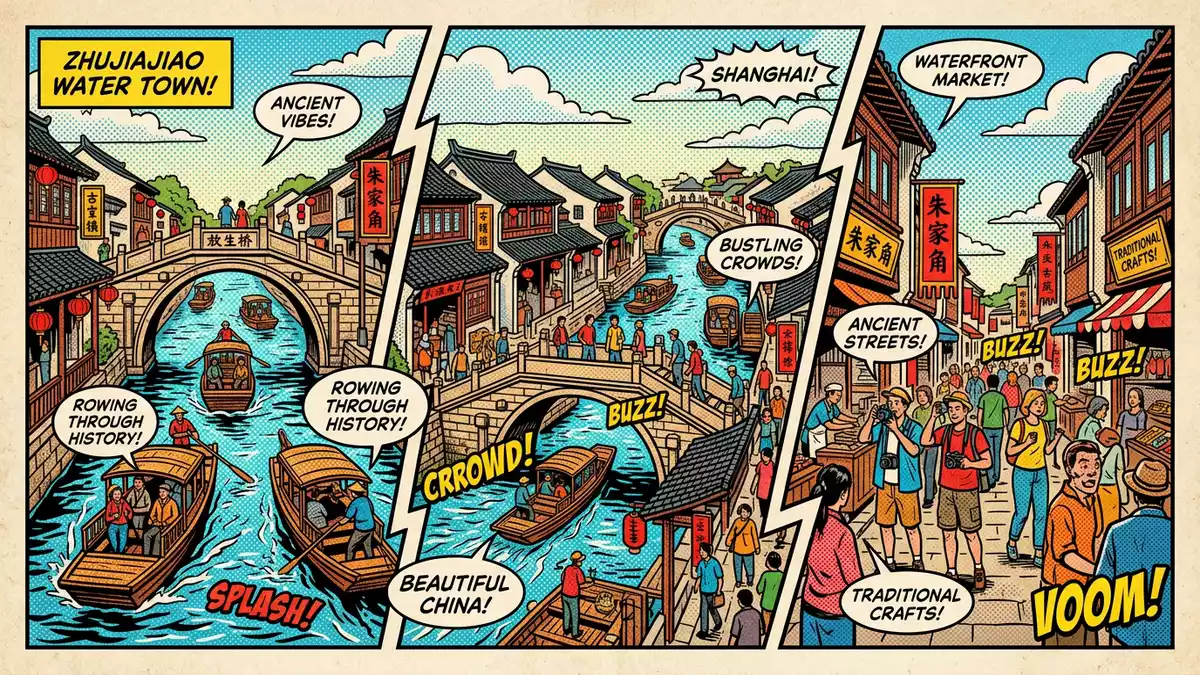
On the western edge of Shanghai, Zhujiajiao is an ancient water town where canals, stone bridges and timber-and-brick houses form a compact historic district threaded by waterways instead of broad streets. Established as a settlement more than 1,700 years ago and now within Qingpu District, it gives a clear view of how a riverside trading town in the Yangtze Delta grew around boats, bridges and narrow lanes.
Canals, bridges and the structure of a water town
Zhujiajiao lies in the south-west of Qingpu District, in the part of Shanghai that borders the lake and lowland landscape of the Yangtze River basin, and its historic core is laid out along a network of canals linked to the Dianpu River and Dianshan Lakesouthwest part of Qingpu District. The town’s plan has long been described as fan-shaped, with streets and canals spreading out from the central area where trading once concentratedlittle fan-shaped town. Along these waterways, stone quays, mooring points and narrow steps down to the canal show how closely everyday movement has been tied to boats.
What travellers notice first is the density of bridges. Zhujiajiao is best known for its spans dating from the Ming and Qing dynasties, built in stone, marble and wood and rising above the canals in a series of arches that link lane to lane and bank to bankbest known for its bridges. The combination of waterways, bridges and low-rise buildings has given Zhujiajiao the informal title “Venice of Shanghai”, reflecting both the setting and the long-standing role of water in its life“The Venice of Shanghai”. Boats still move beneath several of these spans, and the canal edges remain lined with stone, giving the whole area a distinct structure compared with the gridded streets of central Shanghai.
Ming and Qing-era streets and houses
Although people have lived in the Zhujiajiao area for roughly 1,700 years, the streets visitors walk today took their present form largely during the Ming dynasty, founded in 1368, and the Qing dynasty, which began in 1644took shape during the Ming and Qing dynasties. Many of the lane houses, shops and temples date from those periods, and thousands of buildings in the core area still show features from that time, such as timber frames, tiled roofs and stone basesover 10,000 buildings dating back to the Ming and Qing dynasties. The main commercial streets are surfaced with stone, running close to the canals; several are lined with two-storey houses whose upper floors project slightly over the ground floor, giving shade and protection along the walkway.
Within this setting stand formal sites that record the town’s history as a trading and administrative centre. Kezhi Garden, a classical-style garden in the town, blends built structures with planting and paths, reflecting the taste for private gardens among prosperous families in Qing-era ShanghaiKezhi Garden. A Qing dynasty post office and a City God Temple are among the historic buildings open to visitors, both situated within the canal-side streets and showing how communication and worship fitted into the town’s compact fabricQing Dynasty Post Office and City God Temple. Together, these sites sit inside what Shanghai designates as the Zhujiajiao Historical and Cultural Block, recognised in 2005 for its concentration of traditional streets and preserved buildingsZhujiajiao Historical and Cultural Block.
Zhujiajiao in the wider Shanghai landscape
Zhujiajiao sits roughly west of central Shanghai, at a distance of just under 50 km (about 30 miles), and forms part of a belt of ancient canal towns around the citysituated forty-seven kilometers away. The town’s area is recorded at around 47 square kilometres (11,614 acres), with its historic core covering a smaller zone of canals, lanes and houses within that wider footprintcovering an area of 47 square kilometers. It occupies low-lying land near Dianshan Lake and Jiufeng Mountain, with water and flat terrain shaping how streets and building rows follow the canals rather than cutting across them in a straight gridby Dianshan Lake and at the base of Jiufeng Mountain.
Within the broader classification of historic settlements around Shanghai, Zhujiajiao is listed among the four principal ancient towns of the municipality, noted for both its size and its state of preservationtop four cultural ancient towns. Its bridges and canal network, together with the large number of buildings dating to the Ming and Qing dynasties, have helped it retain the character of a canal-based trading town even as Shanghai’s urban area has expanded eastward along the railway lines and expressways. Travellers from Western Europe encounter here a town that belongs administratively to Shanghai yet remains structurally closer to a river port of the early modern period than to a modern high-rise district.
Visiting Zhujiajiao: what travellers from Western Europe should know
- Zhujiajiao lies in Qingpu District, west of central Shanghai, and is reached by road and public transport; Shanghai Metro Line 17 runs to Zhujiajiao Station, from where local buses and a walk lead towards the old town.
- The historic core is largely level but built around canals, with stone-paved streets and several bridges involving stairways; exploring the area means frequent short climbs and descents on stepped approaches.
- Zhujiajiao is in China, where the official language is Chinese and the currency is the renminbi (yuan).
- Entry requirements depend on your nationality; UK travellers can check the FCDO travel advice at gov.uk/foreign-travel-advice, Irish travellers the Department of Foreign Affairs at ireland.ie.
Searching for Zhujiajiao on social platforms
These links open searches for Zhujiajiao on each platform.
Frequently asked questions about Zhujiajiao
Where is Zhujiajiao located?
Zhujiajiao is an ancient water town in Qingpu District on the western side of Shanghai, occupying lowland near Dianshan Lake and the Dianpu River.
What should visitors expect on a visit?
Visitors walk stone-paved streets, cross multiple bridges over canals and encounter historic sites such as Kezhi Garden, a Qing dynasty post office and temples within the designated cultural block.
What makes Zhujiajiao distinctive among Shanghai’s historic towns?
Zhujiajiao combines an extensive canal and bridge network, a large collection of Ming and Qing-era buildings and the formal status of a recognised historical and cultural block within Shanghai.


