
Ziggurat of Ur, a stepped temple tower west of Nasiriya
Published on 09/19/2026 at 07:46 | Editorial responsibility: Rafael Müller, Editor-in-Chief AD HOC NEWS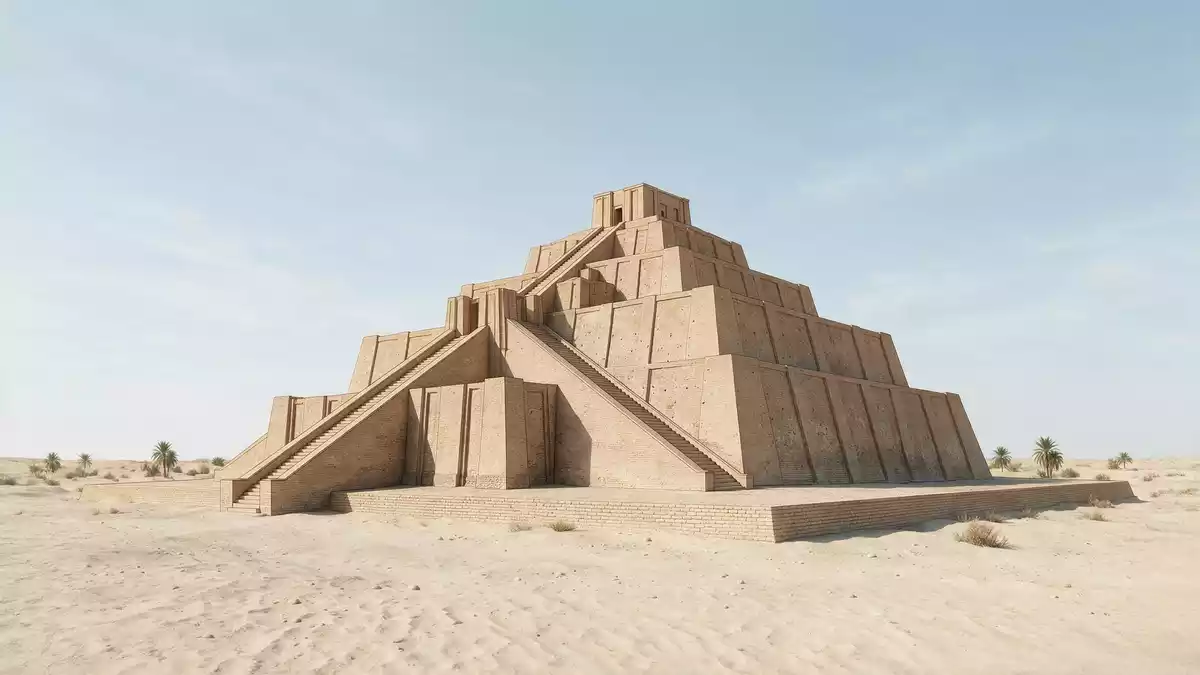
The Ziggurat of Ur near Nasiriya in southern Iraq is a massive stepped temple tower of mud brick rising from the ruins of ancient Ur on the Mesopotamian plain. Standing on the archaeological mound of Tell el-Muqayyar in Dhi Qar Province, it preserves the outline of a Sumerian temple platform built during the Third Dynasty of Ur in the twenty-first century BC.
A mountain of brick for the moon god
The Ziggurat of Ur is a Neo-Sumerian ziggurat located at Tell el-Muqayyar, the site of the ancient city of Ur, in southern Iraq near Nasiriya. Its earliest construction phase belongs to the reign of King Ur-Nammu, founder of the Third Dynasty of Ur, in the early twenty-first century BC, and the structure was completed under his son Shulgi.Third Dynasty of Ur The ziggurat’s ceremonial Sumerian name, Etemenniguru, is commonly translated as “house whose foundation creates awe”, underlining its role as a towering focus of cult for the moon god Nanna, also known as Sîn.Etemenniguru
The temple tower stands as a massive rectangular pyramidal structure built of mud brick with an outer facing of baked brick that helps the form read clearly against the flat alluvial landscape. Archaeological descriptions give its plan as roughly 64 m by 46 m (210 ft by 150 ft), with a sequence of superimposed terrace levels rising to an original height somewhere between 21 m and 30 m (70 ft to 100 ft).rectangular pyramidal structure Grand stairways climb the northern side, converging on the upper terrace where the temple of Nanna once stood, although that shrine has not survived.
Ur, Nasiriya and the Mesopotamian plain
The ziggurat forms the most visible monument within the ruins of ancient Ur, a major Sumerian city that flourished in the third millennium BC on the southern Mesopotamian plain.ancient city of Ur The site lies west of the modern city of Nasiriya in Dhi Qar Governorate, reached by road across the low, level ground of the Euphrates basin.west of Nasiriya From the surrounding plain, the ziggurat appears as a high, stepped mass of brick rising above more eroded architectural remains, its stairways cutting pronounced vertical lines through the horizontal spread of the ruins and the landscape.
The wider archaeological area at Tell el-Muqayyar preserves palace foundations, residential quarters and other temple structures that once clustered around the sacred core marked by the ziggurat.Tell el-Muqayyar Excavations during the twentieth century, including those directed by Leonard Woolley in the 1920s and 1930s, revealed royal tombs and urban layouts that situate the ziggurat within a broader cityscape, even though the stepped tower dominates the view for present-day visitors.
Form, construction and later work
Architecturally, the Ziggurat of Ur belongs to the tradition of Mesopotamian ziggurats, which take the form of tiered platforms lifting a sanctuary above the ground on successively receding stages. At Ur, the core of the structure consists of sun-dried mud bricks laid in thick masses, enclosed by a skin of baked bricks bonded with bitumen, a technique that increases durability against weathering.mud brick and baked brick The visible lower levels and monumental staircases owe much of their present clarity to modern conservation and partial reconstruction.
The ziggurat was built around 2100 BC as part of a wider monumental programme at Ur under Ur-Nammu and Shulgi, integrating the temple to Nanna with surrounding courts and buildings in a sacred precinct. Centuries later, in the sixth century BC, the Babylonian king Nabonidus undertook significant rebuilding at Ur, including restorative work on the ziggurat, reinforcing its lower stages and renewing brick facings.work of Nabonidus In the twenty-first century, the ruins of Ur, including the Ziggurat of Ur, were inscribed as part of the UNESCO World Heritage Site known as the Ahwar of Southern Iraq, recognising both the archaeological significance of the city and its setting within the wetlands and plains of southern Mesopotamia.Ahwar of Southern Iraq
Visiting Ziggurat of Ur: what travellers from Western Europe should know
- The Ziggurat of Ur stands at Tell el-Muqayyar in Dhi Qar Province in southern Iraq, west of the city of Nasiriya, and is reached by road across the flat Mesopotamian plain from Nasiriya and other settlements.
- The monument rises as a stepped brick mass above low archaeological remains, and approaching the base involves walking over uneven ground and climbing broad exterior stairways built into the northern side.
- The official language is Arabic and the currency is the Iraqi dinar.
- Entry requirements depend on your nationality; UK travellers can check the FCDO travel advice at gov.uk/foreign-travel-advice, Irish travellers the Department of Foreign Affairs at ireland.ie.
Searching for Ziggurat of Ur on social platforms
These links open searches for Ziggurat of Ur on each platform.
Frequently asked questions about Ziggurat of Ur
Where is the Ziggurat of Ur located?
The Ziggurat of Ur stands on the archaeological mound of Tell el-Muqayyar in Dhi Qar Province in southern Iraq, west of the modern city of Nasiriya.
What can visitors expect when visiting the Ziggurat of Ur?
Visitors encounter a large stepped brick tower rising above extensive ruins, with exterior stairways, uneven archaeological ground and wide views over the surrounding Mesopotamian plain.
What makes the Ziggurat of Ur distinctive among ancient sites?
Its combination of a clear Neo-Sumerian stepped form, substantial surviving brick mass and direct association with the Third Dynasty of Ur and the cult of the moon god Nanna gives it an exceptional profile among Mesopotamian temple towers.


