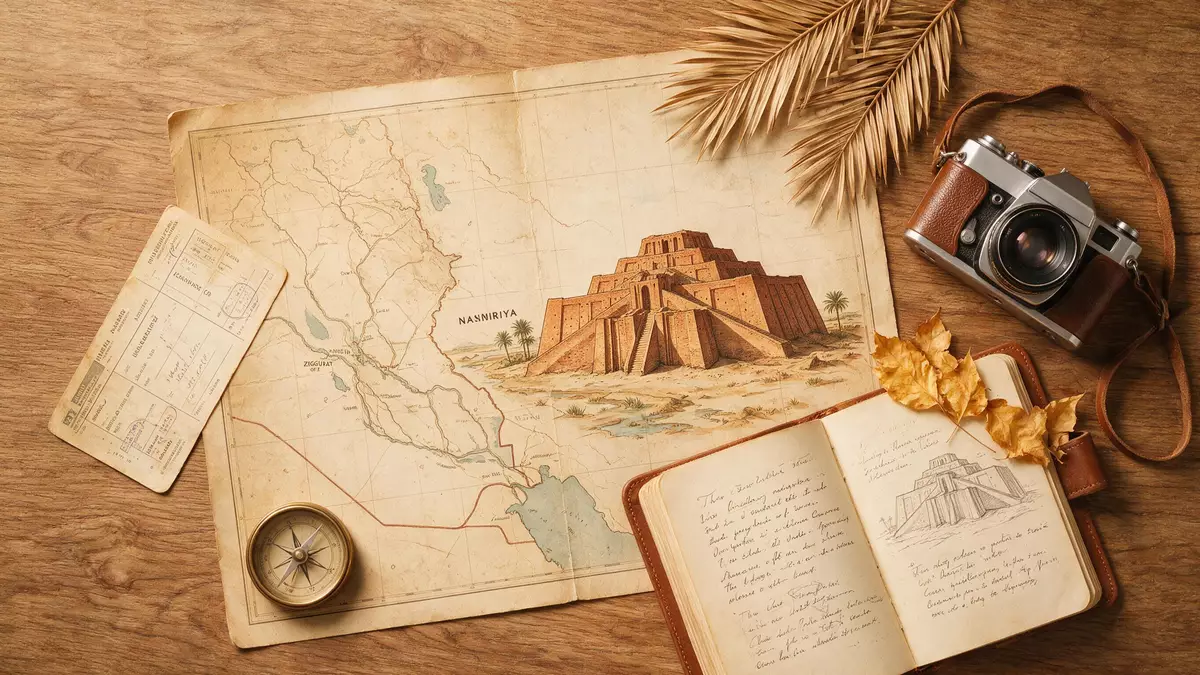
Ziggurat of Ur and its stepped brick mass
Published on 08/11/2026 at 15:16 | Editorial responsibility: Rafael Müller, Editor-in-Chief AD HOC NEWS
Ziggurat of Ur rises as a stepped brick monument from the plain near Nasiriya, with the name of Ur-Nammu tied to its earliest phase and a third-millennium BC setting that still defines it. Its mass is the point: a terraced structure of mud brick and fired brick that makes the ancient city’s religious landscape legible at a glance.
Ur-Nammu’s stepped monument in southern Mesopotamia
The ziggurat belongs to Ur, one of the great cities of ancient Sumer, and its rebuilding is associated with Ur-Nammu of the Third Dynasty of Ur. The core structure belongs to the early second millennium BC, after an earlier phase of temple building in the same city. Its form is a monumental platform tower, set on a broad base and reached by stairways.
That stepped silhouette is the feature that dominates the site. Even in ruins, the brick layers remain readable, and the scale of the platform gives the building a strong geometric presence against the low horizon of southern Iraq.
Brick, stairs and the temple platform
Ur’s ziggurat is built from mud brick, with fired brick used in the outer facing and the surviving lower parts. The structure belonged to a temple precinct, and its terraces once carried a sanctuary at the summit. The building rises in successive stages rather than as a single vertical wall.
The surviving stairways and platforms matter as much as the height. They show how the monument was arranged as a sequence of levels, with the ground plane giving way to a raised religious centre. The result is a building that reads as architecture and earthwork together.
Ur in the landscape of ancient Iraq
The ziggurat sits within the archaeological remains of Ur, a city long associated with the cities, kings and temple institutions of southern Mesopotamia. Its survival is bound to the dry alluvial landscape, where baked brick and sun-dried brick can endure in fragmentary form across long periods.
The site also carries the memory of wider Mesopotamian tradition. Ziggurats appeared in several cities of the region, but Ur’s example remains one of the most important because of its state of preservation and its association with a named royal building campaign.
Visiting Ziggurat of Ur: what travellers from Western Europe should know
- The site is reached from Nasiriya by road.
- Admission arrangements and opening hours are set by the site's operator and change with the season; the official website is the only binding source.
- Late afternoon can be a practical time for seeing the brick surfaces in softer light.
- The monument has steps, uneven ground and exposed archaeological surfaces.
- Arabic is the main language in the area, and cash is the practical form of payment for small purchases nearby.
- Entry requirements depend on your nationality. UK travellers should check the FCDO travel advice at gov.uk/foreign-travel-advice; Irish travellers the Department of Foreign Affairs at ireland.ie; EU and EEA citizens their own national foreign ministry.
Searching for Ziggurat of Ur on social platforms
These links open searches for Ziggurat of Ur on each platform.
Frequently asked questions about Ziggurat of Ur
Where is Ziggurat of Ur?
It stands near Nasiriya in southern Iraq, within the archaeological remains of ancient Ur. The site belongs to the wider Mesopotamian landscape of the lower Euphrates region.
What should a visitor expect?
A visitor sees a large stepped brick monument, open archaeological ground and weathered remains of the ancient temple complex. The approach involves uneven surfaces and exposed ruin terrain.
What makes it distinctive?
Its terraced form, royal association and strong survival in brick make it one of the clearest monumental images of ancient Sumer. The name of Ur-Nammu and the city of Ur remain closely linked to it.