
Zion National Park’s towering sandstone canyon in Springdale
Published on 09/18/2026 at 10:33 | Editorial responsibility: Rafael Müller, Editor-in-Chief AD HOC NEWS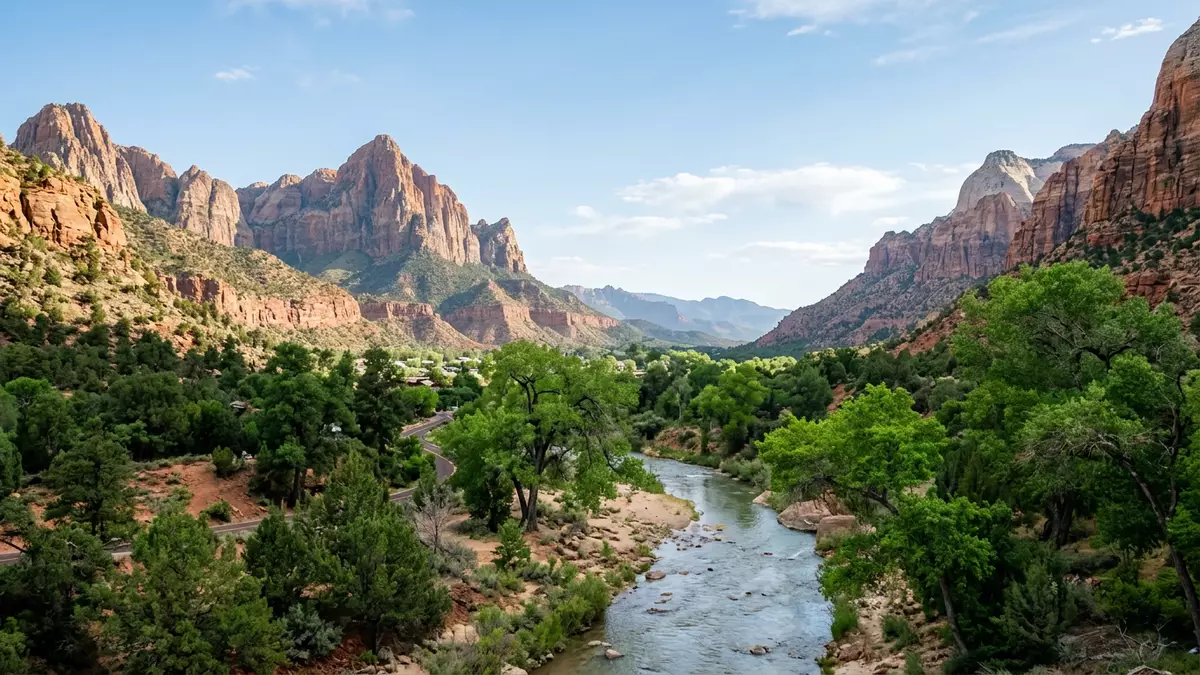
Zion National Park in southern Utah frames the town of Springdale with towering sandstone cliffs and a deep canyon carved by the North Fork of the Virgin River. Established as a national park in 1919, it protects a desert landscape where reddish and tan Navajo Sandstone walls rise steeply above the river corridor and its tributary side canyons.
A desert canyon carved into Navajo Sandstone
The central experience of Zion National Park is Zion Canyon, a deep gorge where the North Fork of the Virgin River has cut down through thick beds of sandstone. The canyon walls are composed largely of Navajo Sandstone, a formation that was created from ancient sand dunes around 180 million years ago and later lithified into rock.ancient sand dunes These cliffs rise hundreds of metres above the valley floor, forming sheer faces that catch changing light through the day.
Within the park, the Virgin River continues to erode the sandstone, sculpting terraces, benches and narrow sections where the walls stand close together above the water. The reddish and tan colour of the canyon reflects iron-rich minerals within the rock and subtle variations in sediment layers.reddish and tan Navajo Sandstone Visitors see vertical cliffs, alcoves and hanging gardens where water seeps from higher strata and supports patches of vegetation against the rock.
From Mukuntuweap to Zion: a protected landscape
Zion National Park grew out of an earlier designation created to safeguard its canyon landscape. In 1909, President William Howard Taft proclaimed Mukuntuweap National Monument, setting aside land around Zion Canyon under the Antiquities Act.Mukuntuweap National Monument The monument was later enlarged and renamed Zion National Monument in 1918, reflecting the name used by local settlers for the canyon.
On 19 November 1919, the United States Congress established Zion National Park, making it the first national park in the state of Utah.Congress established Zion National Park Subsequent additions brought surrounding areas, including Kolob Canyons, into the park boundary, so the protected landscape now encompasses high plateaux, deep gorges and tributary canyons as well as the main Zion Canyon.
Sandstone, the Colorado Plateau and the Grand Staircase
Zion National Park lies on the south-western edge of the Colorado Plateau, a high region where layers of sedimentary rock have been uplifted and eroded. Within this setting, Zion exposes a sequence of formations that record around 150 million years of mostly Mesozoic sedimentation, including the Moenkopi, Chinle, Moenave and Kayenta formations, Navajo Sandstone and Temple Cap Sandstone.sequence of formations The most abundant rock in Zion is sandstone, which forms the vertical canyon walls, shelves and terraces visible throughout the park.sandstone is the most abundant rock
Geologists describe the broader arrangement of rock layers in this part of the Colorado Plateau as the Grand Staircase, a series of colourful cliffs stepping between Bryce Canyon and Grand Canyon. Zion occupies a middle level in this sequence, where Navajo Sandstone and related formations stand above older units and below younger ones.edge of the Colorado Plateau The cliffs around Springdale and within the canyon show cross-bedded patterns, ledges and slopes that reflect differences between river deposits, desert dunes and shallow marine sediments laid down over geological time.
Springdale at the mouth of the canyon
The town of Springdale lies at the west entrance to Zion National Park, where the canyon opens towards the wider Virgin River valley. The lower slopes and cliff bands above the community include exposures of the Springdale Member of the Moenave Formation, a sandstone deposited by ancient rivers that forms a distinct cliff above the town.Springdale Member cliffband Around Springdale, landslide deposits and tipped strata record how weaker layers have allowed overlying rock to move downslope in the past.landslide deposits near Springdale
From Springdale into the park, the canyon narrows as Navajo Sandstone cliffs close in above the river and the road follows bends along the valley floor. Vegetation clusters on ledges, terraces and riparian zones beside the water, contrasting with bare rock faces above. Visitors entering from this side encounter a progression from relatively open valley to enclosed canyon, with the rock architecture becoming more dominant as the route leads deeper between the sandstone walls.
Visiting Zion National Park: what travellers from Western Europe should know
- Zion National Park is in south-western Utah, with Springdale directly outside its western entrance. The area is reached by road routes that connect to regional highways across southern Utah.
- The terrain in Zion Canyon involves steep sandstone cliffs, riverbanks and paths that can include significant gradients. Approaches to higher viewpoints may require extended walking on uneven surfaces.
- Higher sections of the park sit on plateaux above the main canyon, where exposed rock and elevation bring more variable conditions than the valley floor.
- The official language is English and the currency is the United States dollar.
- Entry requirements depend on your nationality; UK travellers can check the FCDO travel advice at gov.uk/foreign-travel-advice, Irish travellers the Department of Foreign Affairs at ireland.ie.
Searching for Zion National Park on social platforms
These links open searches for Zion National Park on each platform.
Frequently asked questions about Zion National Park
Where is Zion National Park located?
Zion National Park is in south-western Utah in the United States, with its main western entrance adjoining the town of Springdale.
What can visitors expect on a visit to Zion National Park?
Visitors encounter steep sandstone cliffs, a river-cut canyon, plateaux and side gorges, with marked contrasts between open valley sections and enclosed narrows.
What makes Zion National Park distinctive among desert landscapes?
Zion combines high Navajo Sandstone cliffs, the North Fork of the Virgin River and a sequence of exposed rock formations on the Colorado Plateau within one compact canyon system.


