
Zona Arqueologica de Tulum above the Caribbean sea
Published on 09/19/2026 at 09:54 | Editorial responsibility: Rafael Müller, Editor-in-Chief AD HOC NEWS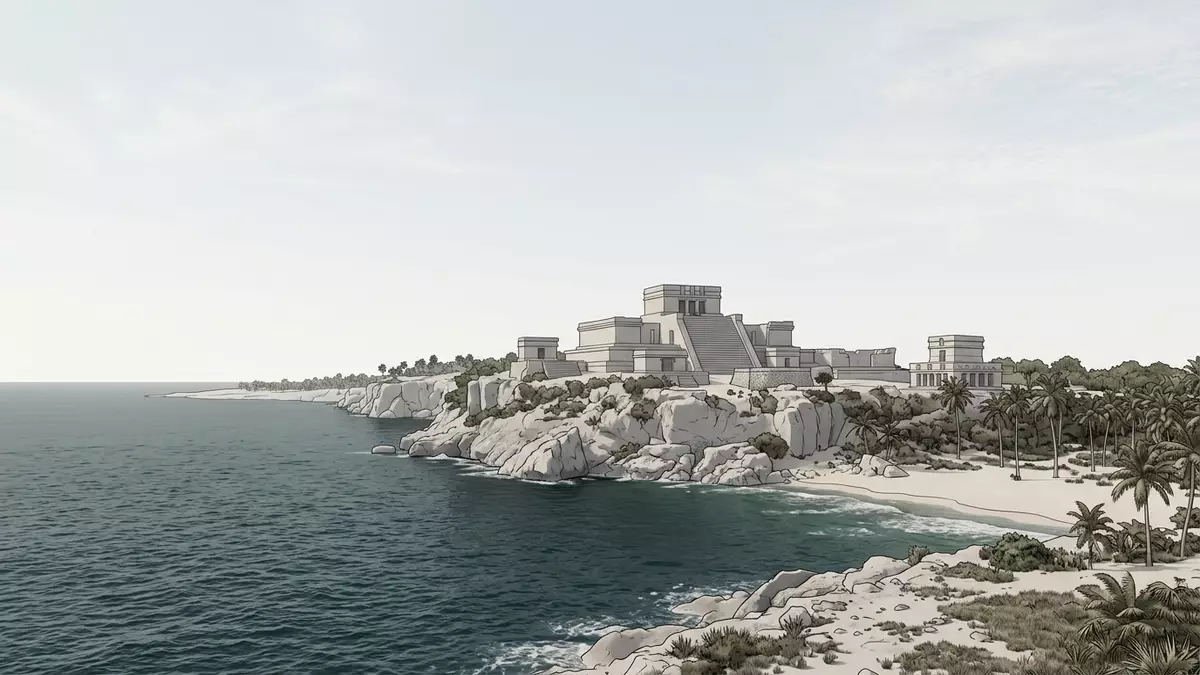
Zona Arqueologica de Tulum is a fortified Maya town on the Caribbean coast of Mexico, where compact stone temples stand on a limestone cliff above the sea. Set near the modern settlement of Tulum in Quintana Roo, the site belongs to the Middle and Late Postclassic period of Maya history and preserves a rare walled layout facing the reef-fringed shoreline.
A walled Maya town on the Caribbean cliff
Zona Arqueologica de Tulum occupies a strip of limestone coast just north-east of the present-day town of Tulum, within the protected area of Parque Nacional Tulum. The main group of structures lies on a bluff above the Caribbean, with the sea to the east and jungle and scrubland stretching inland to the west.Parque Nacional Tulum The ancient town is enclosed on three landward sides by a defensive wall, while the cliff edge forms the fourth side, giving the settlement a clear, compact outline that is easy to read on the ground.
Archaeological work places the visible buildings in the Middle and Late Postclassic, broadly between about 1200 and 1550 CE, the final phase of pre-Hispanic occupation on the Yucatán Peninsula.Middle and Late Postclassic Earlier finds such as Stela 1 from 564 CE suggest that the site’s origins reach back into the Classic period, though the walled townscape visitors see belongs to the later Maya world. Sixteenth-century sources record the Maya name Zamá, meaning “dawn” or “morning”, a reference to the east-facing location, while the present name Tulum, meaning “wall” or “palizada”, reflects the prominence of the enclosure itself.Zamá and Tulum
El Castillo, the Temple of the Frescoes and the cliff edge
The most conspicuous structure at Zona Arqueologica de Tulum is El Castillo, a stepped pyramid-temple that rises close to the cliff, overlooking the Caribbean and the sand beach below.El Castillo pyramid Its platform and shrine stand near the edge of the rock, so that the building forms a landmark both from land and from the sea. This is the tower-like structure described in 1518 by the Spanish chronicler Juan Díaz, who compared the town he saw at Tulum to the size of Seville and noted a tall building rising above it.Juan Díaz description
Within the enclosure, smaller temples and houses line streets and plazas, including the Temple of the Frescoes, a two-level structure that preserves murals and sculpted decoration associated with the Late Postclassic religious life of the town.Temple of the Frescoes The layout reflects Tulum’s role as a coastal port of the ancient province of Ecab, a political entity that controlled much of the north-eastern Yucatán Peninsula in the fifteenth and early sixteenth centuries.province of Ecab From the cliff edge there are clear views out to the reef line of the Mesoamerican Barrier Reef, while inland walls, watchtowers and gateways mark the boundary between the town and the surrounding landscape.
Trade, chronology and twentieth-century research
Zona Arqueologica de Tulum formed part of a wider network of Maya trading ports on the Caribbean coast, linking canoe routes that skirted the reef with inland centres reached overland from the shore. Goods such as salt, honey, cacao and ornamental stones moved through this harbour town, making use of passages through the reef that align with the cliff and temple group.coastal trade routes Archaeological studies describe Tulum as one of the principal Maya cities of the thirteenth and fourteenth centuries, when inland centres were declining and coastal sites played an increasingly important role.principal Maya city
The town remained occupied into the sixteenth century and was abandoned after contact with Spanish expeditions brought disease to the region, echoing the fate of many other Maya communities across the peninsula.abandonment in the sixteenth century Modern archaeological investigation began in 1916 under Sylvanus Morley of the Carnegie Institution of Washington, and the Zona Arqueologica de Tulum was opened formally to public visits in 1939.opening to visitors in 1939 Since then, work by Mexican and international researchers has refined the chronology from earlier Classic remains through the Postclassic fortification and temple building that define the site today.
Visiting Zona Arqueologica de Tulum: what travellers from Western Europe should know
- Zona Arqueologica de Tulum lies north-east of the town of Tulum on the Caribbean coast of Quintana Roo, reached overland along the federal road linking Cancún and Chetumal.
- The archaeological zone stands on a low limestone cliff above the sea, with paths over uneven rock, some steps within the walled precinct and exposed sections near the shore.
- The official language is Spanish and the currency is the Mexican peso; entry requirements depend on your nationality, UK travellers can check the FCDO travel advice at gov.uk/foreign-travel-advice, Irish travellers the Department of Foreign Affairs at ireland.ie.
Searching for Zona Arqueologica de Tulum on social platforms
These links open searches for Zona Arqueologica de Tulum on each platform.
Frequently asked questions about Zona Arqueologica de Tulum
Where is Zona Arqueologica de Tulum located?
Zona Arqueologica de Tulum stands on the Caribbean coast of Quintana Roo in Mexico, just north-east of the modern town of Tulum, within Parque Nacional Tulum.
What can visitors expect to see at the site?
Visitors encounter a compact walled Maya town with stone temples, houses and plazas, including El Castillo near the cliff and the Temple of the Frescoes within the enclosure.
What makes Zona Arqueologica de Tulum distinctive among Maya sites?
Zona Arqueologica de Tulum combines a fortified town layout, an east-facing cliff-edge position above the Caribbean and well-preserved Late Postclassic temples tied to coastal trade routes.


