
Biomuseo in Panama-Stadt: Frank Gehry’s explosion of colour on the canal
Published on 09/17/2026 at 06:27 | Editorial responsibility: Rafael Müller, Editor-in-Chief AD HOC NEWS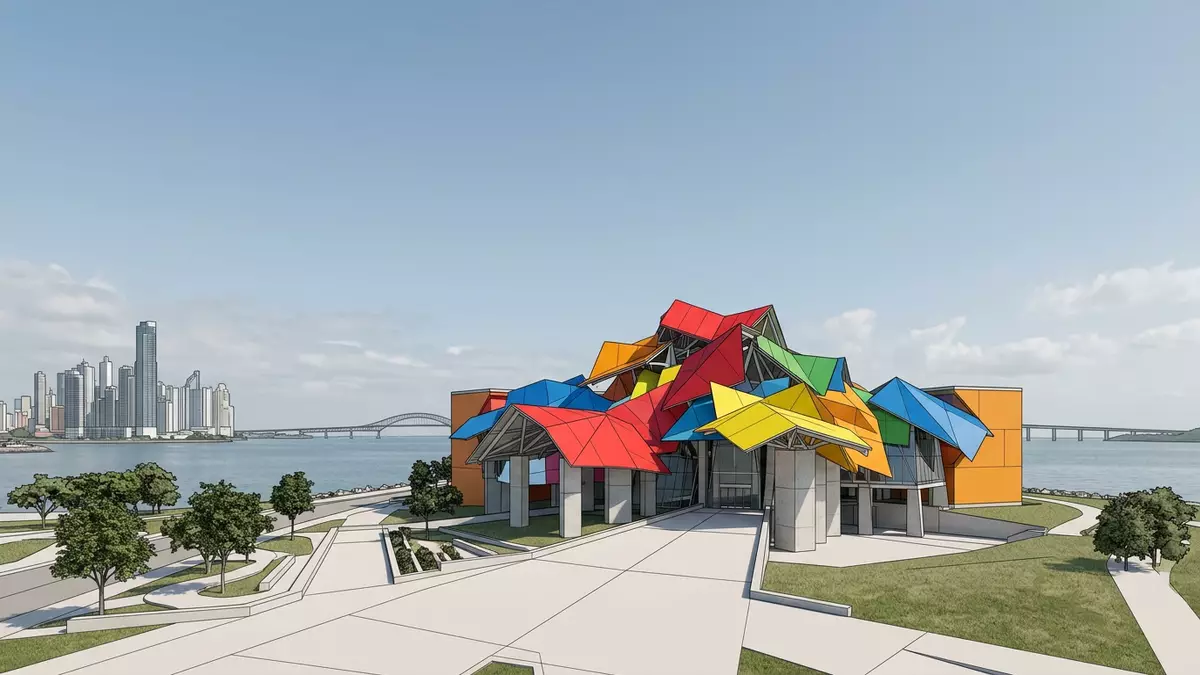
Biomuseo in Panama-Stadt is a museum of biodiversity where Frank Gehry’s angular, brightly coloured roofs frame the story of how Panama’s narrow isthmus changed the planet. Set on the Amador Causeway at the Pacific entrance to the Panama Canal, the building opened in 2014 and has become a landmark of contemporary architecture in Central America.
A riot of colour on the Amador Causeway
Biomuseo occupies a prominent position on the Amador Causeway, a strip of land extending into the bay at the southern entrance to the Panama Canal, with views back towards the skyline of Panama-Stadt and out towards the canal’s shipping lane.The Biodiversity Museum: Panama Bridge of Life describes its location on the causeway as a point where the city meets the Pacific Ocean and the engineered waterway. The site was part of the Amador Peninsula, a territory linked historically to United States military use, and is now a place where leisure promenades, viewpoints and the museum’s gardens share the waterfront.Biomuseo, Panama City notes its position facing Panama City from a peninsula formerly occupied as a base.
The building itself is defined by overlapping metal roof planes painted in saturated reds, yellows, blues and greens that appear to tumble over one another, creating a jagged silhouette against the sky.Biomuseo: Frank Gehry’s kaleidoscope of biodiversity in Panama-Stadt emphasises how these saturated colours give the shoreline an instantly recognisable outline. Underneath this collage of form and colour, an open-air public atrium sits at the centre of the composition, covered by the colourful steel canopies and surrounded by paths that lead into the galleries and out into the botanical park around the building.El Biomuseo describes this atrium as a public space sheltered by the roof while remaining open to the air.
Frank Gehry’s first Latin American museum of biodiversity
Biomuseo is the first building in Latin America designed by Canadian-born architect Frank Gehry, whose practice Gehry Partners conceived the museum around 1999.Biomuseo notes that the design was conceived in 1999 and that the museum opened on 2 October 2014, while Arquitectura Viva records 2014 as the completion date. The project involved Gehry Partners alongside partners such as Terry Bell, Bill Childers and Anand Devarajan, giving the building a clear place within Gehry’s wider body of work.
The museum is dedicated to the natural history and biodiversity of Panama, framing the emergence of the isthmus and its impact on life across the Americas.El Biomuseo describes how the building is designed to tell the story of the Isthmus of Panama rising from the sea, connecting the continents of North and South America and dividing a large ocean in two. Inside, galleries developed by Bruce Mau Design and scientific teams from the Smithsonian Institution and the University of Panama present themes such as the formation of Panama, the mixing of species and the relationship between human societies and ecosystems.CLADglobal’s feature on Biomuseo notes that the scientific content was researched and curated by these institutions, with galleries created by Bruce Mau Design.
Galleries, gardens and the story of an isthmus
Biomuseo’s interior is organised around a central atrium, with galleries branching out to explore different aspects of Panama’s biodiversity and geological history.WikiArquitectura’s overview of the BioMuseo describes eight permanent exhibition galleries on two levels, together with spaces for temporary exhibitions and aquariums showing marine life from the Pacific Ocean and the Caribbean Sea. The official tourism description identifies named exhibition spaces such as “Building The Bridge”, focusing on how Panama was formed, and “Worlds Collide”, presenting animals that migrated through the region as the land bridge emerged.Biomuseo, Panama - Biodiversity Museum & Nature Exhibits lists these galleries and their themes as part of the museum experience.
Beyond the indoor exhibitions, Biomuseo extends into a botanical park that wraps around the building, with outdoor displays and planting that echo Panama’s tropical landscapes.Biomuseo de Panama, Color and Curved steel… explains that landscape architect Edwina von Gal & Company designed the surrounding park and public space, which includes external areas for exhibitions within the botanical garden. Paths flow between shaded areas under the roof canopies, planted terraces and viewpoints towards the canal, making the museum’s setting part of the visit. The Amador Foundation, established in 2000, is responsible for the operation and care of the building, linking the architecture, exhibitions and gardens under a single stewardship.The Amador Foundation’s role is described as maintaining the museum and its grounds.
Visiting Biomuseo: what travellers from Western Europe should know
- Biomuseo stands on the Amador Causeway at the Pacific entrance to the Panama Canal, south of the central districts of Panama-Stadt, and can be reached by road and by public bus services serving the causeway.
- The museum building rises in multiple levels, with internal ramps and staircases linking the atrium to the galleries, while the surrounding botanical park includes outdoor paths and terraces on uneven ground.
- The official language is Spanish and the currency is the Panamanian balboa, which is used alongside the United States dollar in everyday transactions.
- Entry requirements depend on your nationality; UK travellers can check the FCDO travel advice at gov.uk/foreign-travel-advice, Irish travellers the Department of Foreign Affairs at ireland.ie.
Searching for Biomuseo on social platforms
These links open searches for Biomuseo on each platform.
Frequently asked questions about Biomuseo
Where is Biomuseo located in Panama-Stadt?
Biomuseo stands on the Amador Causeway, a waterfront strip at the Pacific entrance to the Panama Canal, south of central Panama-Stadt.
What can visitors expect inside Biomuseo?
Visitors encounter galleries on Panama’s geological formation and biodiversity, aquariums showing marine life, a central atrium and a surrounding botanical park with outdoor exhibits.
What makes Biomuseo distinctive among museums?
Biomuseo combines Frank Gehry’s vividly coloured, fragmented roofscape with exhibitions focused on how Panama’s isthmus connected continents and reshaped the ecology of the Americas.


