
Centro Historico de Morelia and its pink stone street grid
Published on 09/21/2026 at 07:04 | Editorial responsibility: Rafael Müller, Editor-in-Chief AD HOC NEWS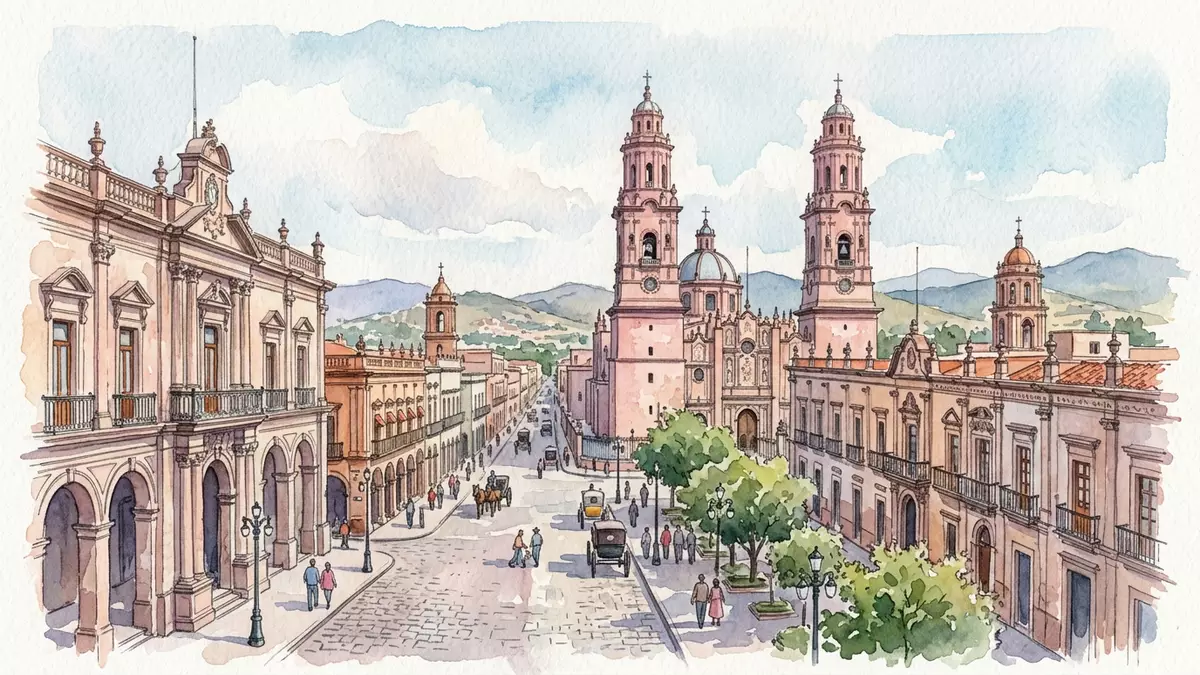
Centro Historico de Morelia, the historic centre of Morelia in Mexico, is a colonial cityscape laid out on a straight street grid and built largely from warm pink volcanic stone. Set on the slopes of a valley in the Mexican state of Michoacán, it forms a coherent ensemble of streets, squares and church towers recognised as the Historic Centre of Morelia on the UNESCO World Heritage List since 1991.
A sixteenth-century grid in pink stone
The core of Centro Historico de Morelia was laid out in the sixteenth century as a Spanish colonial city planned on a checkerboard of straight streets that climb and descend the central hill of the valley. The UNESCO description of the Historic Centre of Morelia highlights this Renaissance-inspired street plan, combining Iberian town-planning theories with the experience of urban life in central Mexico.Historic Centre of Morelia Within this grid, blocks of houses and public buildings create a regular rhythm of corners, arcades and courtyards that makes the plan legible when walking across the centre.
Throughout this urban fabric, Centro Historico de Morelia is characterised by the extensive use of cantera rosa, a pink volcanic stone quarried in the region and used as the main construction material for churches, houses and civic monuments.pink volcanic stone The stone gives facades a warm rose-coloured tone that shifts with the daylight, visually linking religious and civil architecture and making the grid feel like a single, continuous cityscape. More than 200 historic buildings in this material crystallise the architectural history of the city across several centuries.more than 200 historic buildings
Baroque towers, neoclassical fronts and civic ensembles
Centro Historico de Morelia is not defined by a single monument but by the density of churches, colleges, houses and palaces that line its streets. The central part of the historic centre includes a large number of monuments of prime importance, among them churches and civil constructions that together trace the city’s evolution from the sixteenth to the nineteenth century.central part of the historic centre Many church fronts in the area belong to the Baroque and neoclassical tradition, their stonework articulated into pilasters, niches and cornices that catch the light along the main streets.Baroque and neoclassical elements
Above the grid, towers and cupolas define the skyline. The cathedral near the heart of Centro Historico de Morelia rises with twin towers in pink stone, setting a vertical accent against the predominantly horizontal lines of the street plan.cathedral and church towers Elsewhere in the centre, former college buildings and palaces with arcaded fronts form ensembles around plazas, their proportions and detailing reflecting the blend of medieval spirit with Renaissance, Baroque and neoclassical elements described in the UNESCO listing.blend of architectural styles
World Heritage status and setting in Michoacán
Centro Historico de Morelia is the historic centre of the city of Morelia, capital of the Mexican state of Michoacán in central Mexico, at the foot of the Sierra Madre Occidental and close to the agricultural valley of Morelia-Querendaro.city of Morelia in Michoacán The terrain gives the grid a slight incline, with streets adjusting to the slopes of the hill site while retaining their straight, orthogonal pattern.
UNESCO inscribed the Historic Centre of Morelia on the World Heritage List in 1991 as a cultural property, recognising its urban plan and architecture shaped mainly between the sixteenth and eighteenth centuries.inscribed on the UNESCO World Heritage List in 1991 The listing records criteria ii, iv and vi, emphasising the centre as an outstanding example of urban development and as a place associated with historical traditions in Mexico.UNESCO criteria ii, iv and vi Within this protected area, the continuity of pink stone buildings and the survival of the original grid make Centro Historico de Morelia a concentrated record of several centuries of Mexican architecture contained within a single city core.
Visiting Centro Historico de Morelia: what travellers from Western Europe should know
- Centro Historico de Morelia lies in the city of Morelia, capital of the state of Michoacán in central Mexico, at the foot of the Sierra Madre Occidental and near the agricultural valley of Morelia-Querendaro.
- The centre is laid out on an urban grid that climbs the slopes around the central hill, so walking the streets involves gradual inclines and level changes rather than flat ground.
- The historic core is dense with stone-built streets and plazas, and many of its churches and civic buildings front directly onto the pavements, making exploration on foot a sequence of short links between monuments.
- Spanish is the official language and the currency is the Mexican peso.
- Entry requirements depend on your nationality; UK travellers can check the FCDO travel advice at gov.uk/foreign-travel-advice, Irish travellers the Department of Foreign Affairs at ireland.ie.
Searching for Centro Historico de Morelia on social platforms
These links open searches for Centro Historico de Morelia on each platform.
Frequently asked questions about Centro Historico de Morelia
Where is Centro Historico de Morelia located?
Centro Historico de Morelia is the historic centre of the city of Morelia, capital of the state of Michoacán in central Mexico, at the foot of the Sierra Madre Occidental.
What should visitors expect on a walk through the centre?
Visitors encounter a straight street grid rising and falling with the terrain, lined with pink stone facades, churches, college buildings and palaces that together form a coherent colonial cityscape.
What makes Centro Historico de Morelia distinctive among Mexican historic centres?
The combination of a sixteenth-century checkerboard plan, extensive use of regional pink volcanic stone and a concentration of Baroque and neoclassical architecture gave the Historic Centre of Morelia its UNESCO World Heritage status in 1991.


