
Naos tou Olympiou Dios and its marble colonnade in Athen
Published on 09/21/2026 at 14:18 | Editorial responsibility: Rafael Müller, Editor-in-Chief AD HOC NEWS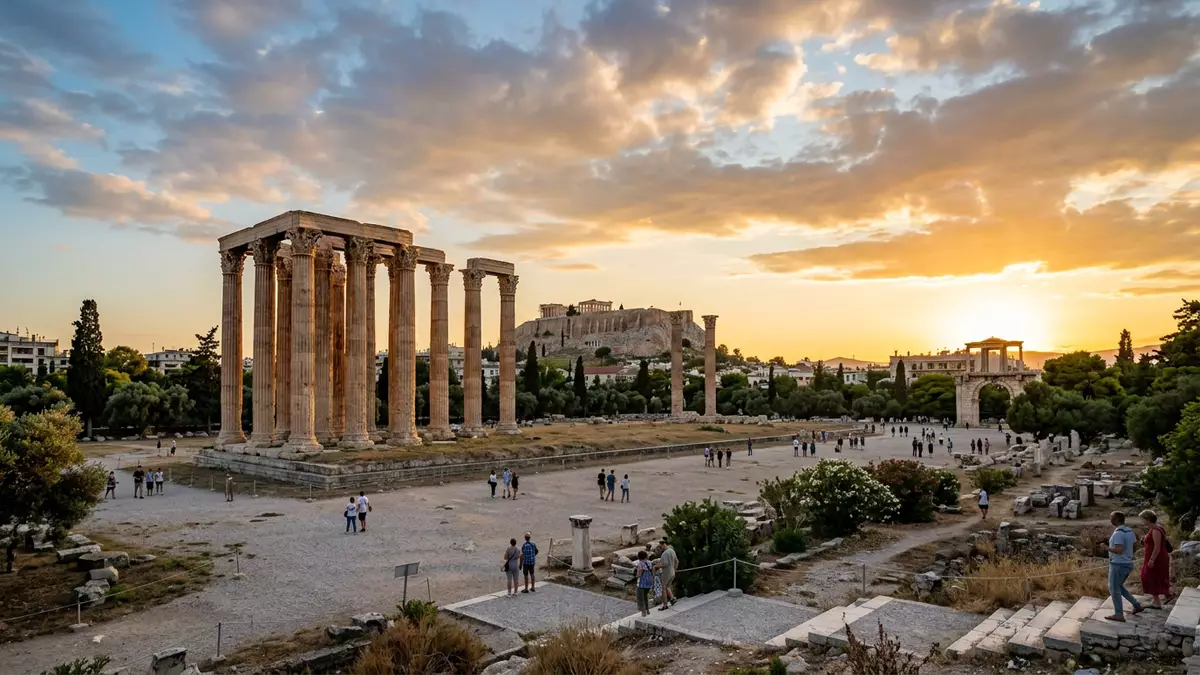
Naos tou Olympiou Dios, better known in English as the Temple of Olympian Zeus, lays out a broad field of marble columns in central Athen, framed by the Acropolis and the line of the former Ilissos river. Begun in the sixth century BC and completed under the Roman emperor Hadrian in the second century AD, it condenses centuries of Greek and Roman building into a single ruined colonnade.
A colossal temple in marble and air
The first impression of Naos tou Olympiou Dios is its scale: a long rectangle of Pentelic marble columns rising from a flat terrace of stone within a fenced archaeological precinct.Pentelic marble columns Even as a ruin, the temple reads as one of the largest sanctuaries of antiquity, its footprint extending across the open ground south-east of the Acropolis in a regular grid of foundations and standing shafts.a broad grid of marble columns
The temple was laid out as a peripteral structure: a long central cella flanked by rows of Corinthian columns running along the long sides and across the short ends, creating a continuous colonnade around the core of the building.peripteral temple in the Corinthian order In its completed form in the second century AD it stood among the largest temples of the ancient Mediterranean, and the surviving columns still mark out the height and rhythm that once framed the sanctuary space.
From Peisistratid foundations to Hadrian’s dedication
The building history of Naos tou Olympiou Dios stretches over more than six centuries, linking the Archaic, Hellenistic and Roman periods into a single monument.built across the Hellenistic and Roman periods Work began in the sixth century BC under the Athenian tyrant Pisistratus, when an ambitious Doric scheme was set out on the flat ground south-east of the Acropolis but remained unfinished after the expulsion of his son Hippias in 510 BC.sixth-century BC foundations under the Peisistratid tyrants
In the second century BC the Seleucid king Antiochus IV Epiphanes revived the project and invited the Roman architect Decimus Cossutius to redesign the temple in the Corinthian order, shifting the sanctuary towards a more elaborate, Hellenistic expression of grandeur.Antiochus IV Epiphanes and Decimus Cossutius The temple reached completion only under Emperor Hadrian in the early second century AD, when the sanctuary was dedicated to Zeus Olympios as part of a wider programme of imperial building in Athen.completion under Hadrian in 131 CE
Columns, drums and the open archaeological field
Originally Naos tou Olympiou Dios carried 104 Corinthian columns of Pentelic marble, each rising to around 17 m (about 56 ft) and crowned with elaborately carved capitals, a number that underlines the ambition of the project.104 Corinthian columns about 17 metres tall Today a group of tall columns stands in roughly two parallel files, with one fallen column lying as a line of offset drums on the ground, exposing the way each shaft was built from stacked cylindrical blocks.
The temple precinct occupies an open archaeological field south-east of the Acropolis, close to the line of the former Ilissos river and near the surviving arch known as Hadrian’s Gate, so the colonnade reads against both the rock of the Acropolis and the denser fabric of modern Athen.between the Acropolis and the Ilissos Within the enclosure low walls and foundation lines trace the outline of the temple, while scattered column drums and fragments of entablature give a sense of the architectural detailing that once ran continuously around the structure.
Visiting Naos tou Olympiou Dios: what travellers from Western Europe should know
- Naos tou Olympiou Dios lies south-east of the Acropolis in Athen, within an enclosed archaeological area that also includes the remains of the ancient sanctuary and stands near Hadrian’s Gate.
- The archaeological field is largely open ground with short grass and paths across uneven stone and soil, and the surviving columns stand on a slightly raised terrace reached by broad steps.
- The site sits between the line of the former Ilissos river and major city streets, so the temple precinct adjoins both archaeological remains and the built-up urban fabric of central Athen.
- The official language is Greek and the currency is the euro.
Searching for Naos tou Olympiou Dios on social platforms
These links open searches for Naos tou Olympiou Dios on each platform.
Frequently asked questions about Naos tou Olympiou Dios
Where is Naos tou Olympiou Dios located in Athen?
Naos tou Olympiou Dios stands south-east of the Acropolis in central Athen, between the former course of the Ilissos river and major city streets.
What should visitors expect at the site?
Visitors encounter an open archaeological field with standing Corinthian columns, foundation lines of the former temple and scattered marble fragments across the precinct.
What makes Naos tou Olympiou Dios distinctive among ancient sites?
Its long building history from the sixth century BC to Hadrian’s dedication and its forest of tall Corinthian columns give Naos tou Olympiou Dios a rare combination of scale and layered chronology.


