
Persepolis, the stone terrace of the Achaemenid kings
Published on 09/18/2026 at 13:46 | Editorial responsibility: Rafael Müller, Editor-in-Chief AD HOC NEWS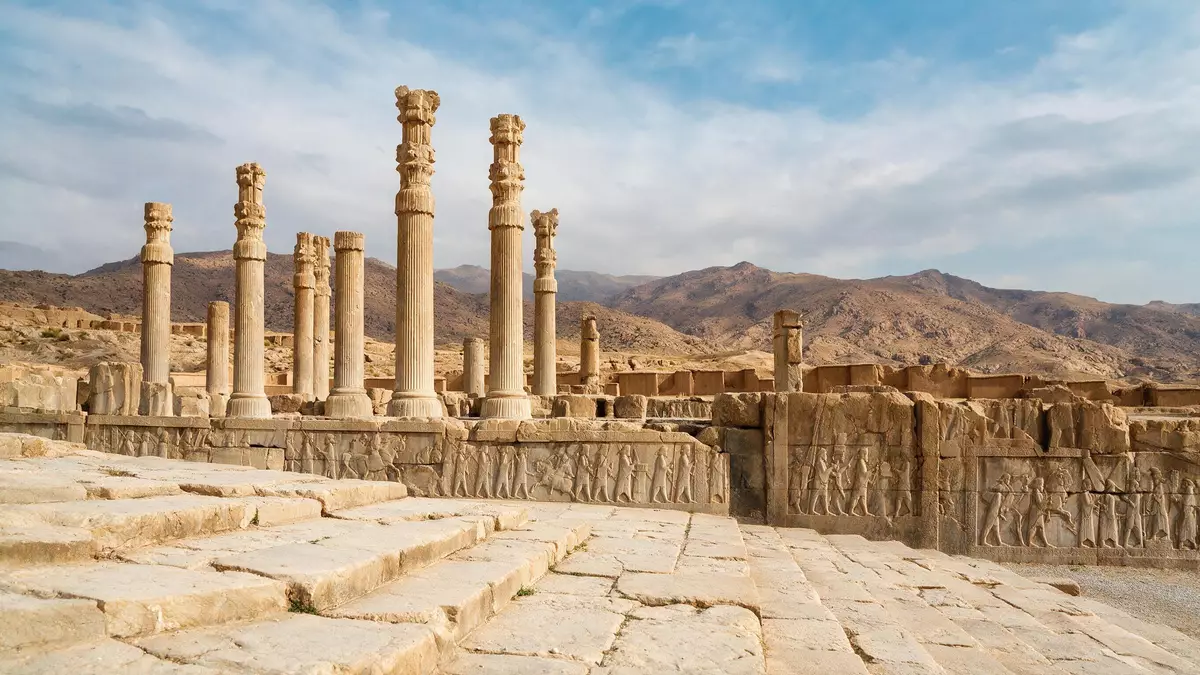
Persepolis near Shiraz in southern Iran is an ancient royal complex raised on a broad stone terrace at the foot of Kuh-e Rahmat, the “Mountain of Mercy”. Founded under Darius I in the late sixth century BC as a ceremonial capital of the Achaemenid Empire, it concentrates palaces, audience halls and gateways in a single platform above the Marvdasht plain in Fars Province.
The Achaemenid ceremonial capital on the Marvdasht plain
The ruins of Persepolis lie in the plains of Marvdasht in Fars Province, north-east of Shiraz, framed by low limestone slopes of the southern Zagros Mountains and close to the confluence of the Pulvar and Kor rivers. The complex was founded by Darius I around 518 BC as a formal centre of the Achaemenid Empire, which had emerged under Cyrus the Great and extended across much of Western and Central Asia.Founded by Darius I in 518 BC On the plateau above the plain, the king and his successors created an ensemble of palaces and halls whose remains still mark the ceremonial heart of ancient Persia.The site lies north-east of Shiraz in the Fars region
The city’s Old Persian name P?r?a, echoed in the New Persian Takht-e Jamshid, refers to the “city of Persians”. Persepolis itself is the Greek form that passed into international usage and now names the archaeological site. The earliest remains on the terrace date to the early fifth century BC, with building phases continuing under Xerxes I and Artaxerxes I as the complex grew into a dense concentration of royal architecture.The earliest remains date back to 515 BCE From the plain below, the stepped platform and scattered columns give a clear sense of a planned ceremonial centre rather than a sprawling lived-in city.
The great stone terrace and its palaces
Persepolis stands on an immense half-artificial, half-natural terrace of limestone, cut and filled to create a nearly level platform above the surrounding fields.It was built on an immense half-artificial, half-natural terrace Access from the plain leads through monumental stairways whose broad steps rise gently to the platform, setting a measured rhythm for any approach. At the top, the foundations and standing columns of palaces, treasuries and audience halls are laid out in ordered groups, each raised on its own sub-platform and aligned with the overall grid of the terrace.
Even in ruin, the main audience halls are defined by forests of tall stone columns and massive bases that once carried roofs over vast interior spaces. The Apadana, traditionally identified as one of the principal audience halls of Darius I, is marked by rows of column bases and relief-decorated staircases that still retain detailed carving.Persepolis is one of the key Iranian cultural heritage sites Elsewhere on the terrace, the remains of smaller palatial units suggest residential and administrative functions linked to the ceremonial core, all integrated into the single elevated platform above the Marvdasht plain.
Reliefs, inscriptions and World Heritage status
Much of Persepolis’s character lies in its carved stone reliefs, which line staircases, gateways and retaining walls across the terrace. These reliefs show processions of royal guards and delegations from different lands bringing offerings, as well as lions, bulls and floral motifs such as lotuses, all carved into the limestone with a high degree of precision.Reliefs of guards, delegates, lions and bulls line the stone surfaces Inscribed panels in Old Persian, Elamite and Babylonian scripts record royal names and titles, fixing the terrace within the historical framework of Achaemenid rule.
The importance and quality of the monumental ruins, their association with named Achaemenid kings and the scale of the terrace led to the inscription of Persepolis on the UNESCO World Heritage List in 1979 as a cultural property.Persepolis was inscribed on the UNESCO World Heritage List in 1979 UNESCO recognises the site as a masterpiece of human creative genius and an exceptional testimony to Achaemenid civilisation and its architectural achievement.Persepolis meets criteria including a masterpiece of human creative genius For visitors, this formal status underscores that the stone terrace, palaces and reliefs form a single protected archaeological landscape rather than isolated ruins.
Visiting Persepolis: what travellers from Western Europe should know
- Persepolis lies north-east of Shiraz in Fars Province, reached overland by road across the cultivated Marvdasht plain, where the stone terrace rises visibly against the limestone ridge of Kuh-e Rahmat.
- The archaeological site is set on an elevated terrace above the plain, and a visit involves walking up broad external stairways and exploring uneven stone surfaces, with some areas exposed on the edge of the platform.
- The official language is Persian and the currency is the Iranian rial.
- Entry requirements depend on your nationality; UK travellers can check the FCDO travel advice at gov.uk/foreign-travel-advice, Irish travellers the Department of Foreign Affairs at ireland.ie.
Searching for Persepolis on social platforms
These links open searches for Persepolis on each platform.Frequently asked questions about Persepolis
Where is Persepolis and how is it related to Shiraz?
Persepolis is an archaeological site in the Marvdasht plain of Fars Province in south-western Iran, north-east of Shiraz, on a stone terrace at the foot of Kuh-e Rahmat.
What should visitors expect when exploring the site?
A visit centres on walking up broad stairways to the elevated terrace, then moving among stone foundations, standing columns and carved reliefs that mark palaces, halls and gateways across the open platform.
What makes Persepolis distinctive among ancient sites?
Persepolis brings together a vast terraced platform, monumental columned halls, richly carved reliefs and inscriptions linked to named Achaemenid kings, forming a single ensemble recognised as a UNESCO World Heritage Site since 1979.


