
Piazza del Campo and the brick theatre of Siena
Published on 08/25/2026 at 16:35 | Editorial responsibility: Rafael Müller, Editor-in-Chief AD HOC NEWS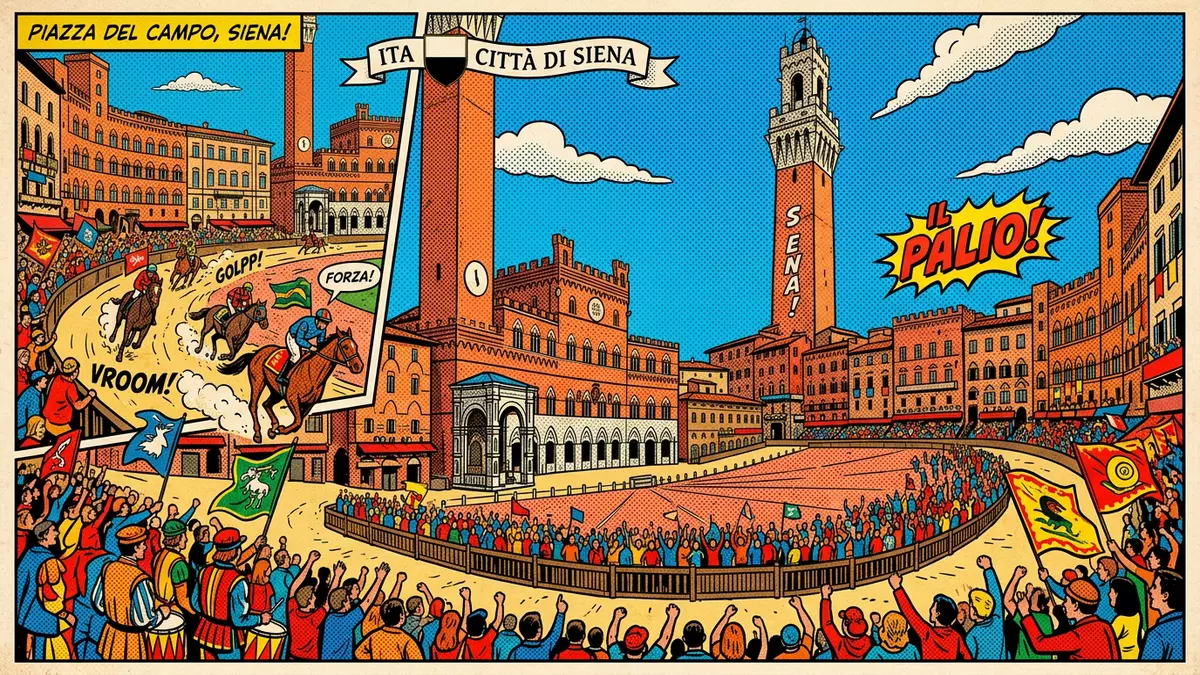
Piazza del Campo is the great brick-paved square at the centre of Siena in Tuscany, laid out as a gently sloping shell that gathers the city into a single open space in front of the Palazzo Pubblico. In its present form it belongs to the late thirteenth and fourteenth centuries, when the republican Government of the Nine shaped Siena’s civic heart around this distinctive piazza.
A shell-shaped stage of brick and stone
Seen from above, Piazza del Campo forms a broad fan that drops towards the Palazzo Pubblico, with the slope following the natural hollow where three medieval hilltop communities met. The paving is laid in red brick, arranged in bands that radiate from the lower edge and are separated by pale travertine lines into nine sectors that recall the Government of the Nine, the ruling council that directed Siena’s affairs between the late thirteenth century and the mid-fourteenth century.Nine sectors marked by travertine Standing on the upper side, these lines create a visual rhythm across the slope, pulling the eye down towards the civic buildings that anchor the square.
The piazza’s outline grew on a site already used as a market in the twelfth century, when documents of 1169 mention a valley known as Campus Sancti Pauli that extended over what is now the Campo and the neighbouring market square.The first documented mention dates to 1169 By the end of that century Siena had divided the ground into two separate spaces, reserving the Campo for fairs and general markets. The brick surfacing dates from the fourteenth century, when the layout familiar today replaced an earlier unpaved field.
Palazzo Pubblico and Torre del Mangia
The lower side of Piazza del Campo is dominated by the Palazzo Pubblico, Siena’s Gothic town hall in red brick and stone that has housed civic government since the last years of the thirteenth century.Palazzo Pubblico on the Campo’s lower side Its long facade presents arcaded ground-floor openings and tall windows above, unified by battlements and a slightly projecting central section, so that the building reads as a continuous backdrop to the square rather than an isolated block. Inside, historic rooms preserve frescoes from Siena’s medieval republican period, making the Palazzo Pubblico both a working town hall and a repository of civic art.
Rising beside the Palazzo Pubblico is the Torre del Mangia, the slender campanile-like civic tower that provides a vertical counterpoint to the horizontal sweep of the piazza. Construction of this tower began in 1325 and was completed in the middle decades of the fourteenth century, giving Siena one of Italy’s tallest secular towers at around 102 m (335 ft) in height.Construction of the tower began in 1325 The stone upper section with its clock crowns a brick shaft that rises directly from the town hall, tying the tower visually to the building below and marking the square as Siena’s civic stage.
Medieval Siena gathered around the Campo
Piazza del Campo stands at the convergence of three main streets that link the historic districts of Siena, providing a neutral civic ground between the neighbourhoods that once formed separate communities.The Campo lies at the intersection of three main roads In the thirteenth and fourteenth centuries the Government of the Nine set out strict regulations for the facades facing the piazza, requiring coherent heights and materials so that the surrounding palazzi would form a continuous architectural front. As a result, the brick and stone houses stepping around the curve share a consistent scale, with their shopfronts and arcades arranged to follow the slope.
Over the centuries the Campo has served as Siena’s principal gathering place for civic ceremonies, markets and festivities, including the Palio di Siena, the celebrated horse races that circle the perimeter of the square. The historic centre of Siena, with Piazza del Campo at its heart, forms part of a UNESCO World Heritage site that recognises the city’s medieval urban fabric and the way the square integrates religious, commercial and governmental buildings within a single space.The historic centre of Siena, including the Campo, is inscribed as a World Heritage Site The combination of shell-shaped paving, Gothic civic architecture and the continuous ring of houses makes the piazza a characteristic expression of communal life in medieval Tuscany.
Visiting Piazza del Campo: what travellers from Western Europe should know
- Piazza del Campo lies in the historic centre of Siena in Tuscany, Italy, a short walk from the Duomo along narrow medieval streets that open suddenly onto the wide brick square.
- The surface of the piazza slopes gently towards the Palazzo Pubblico, and the brick paving can be uneven in places, so walking involves modest gradients and changes in level.
- The official language is Italian and the currency is the euro.
Searching for Piazza del Campo on social platforms
These links open searches for Piazza del Campo on each platform.
Frequently asked questions about Piazza del Campo
Where is Piazza del Campo?
Piazza del Campo is the main square of Siena, a historic city in the Italian region of Tuscany, and sits within the city’s medieval centre.
What should visitors expect on a visit?
Visitors encounter a shell-like brick piazza that slopes towards the Palazzo Pubblico and Torre del Mangia, framed by Gothic houses and cafes around the curve.
What makes Piazza del Campo distinctive?
The combination of its nine-part shell layout, brick paving, Gothic town hall and tall civic tower gives Piazza del Campo a characteristic medieval character among Italian squares.


