
Pitons rising above Soufriere’s Caribbean coast
Published on 09/19/2026 at 21:03 | Editorial responsibility: Rafael Müller, Editor-in-Chief AD HOC NEWS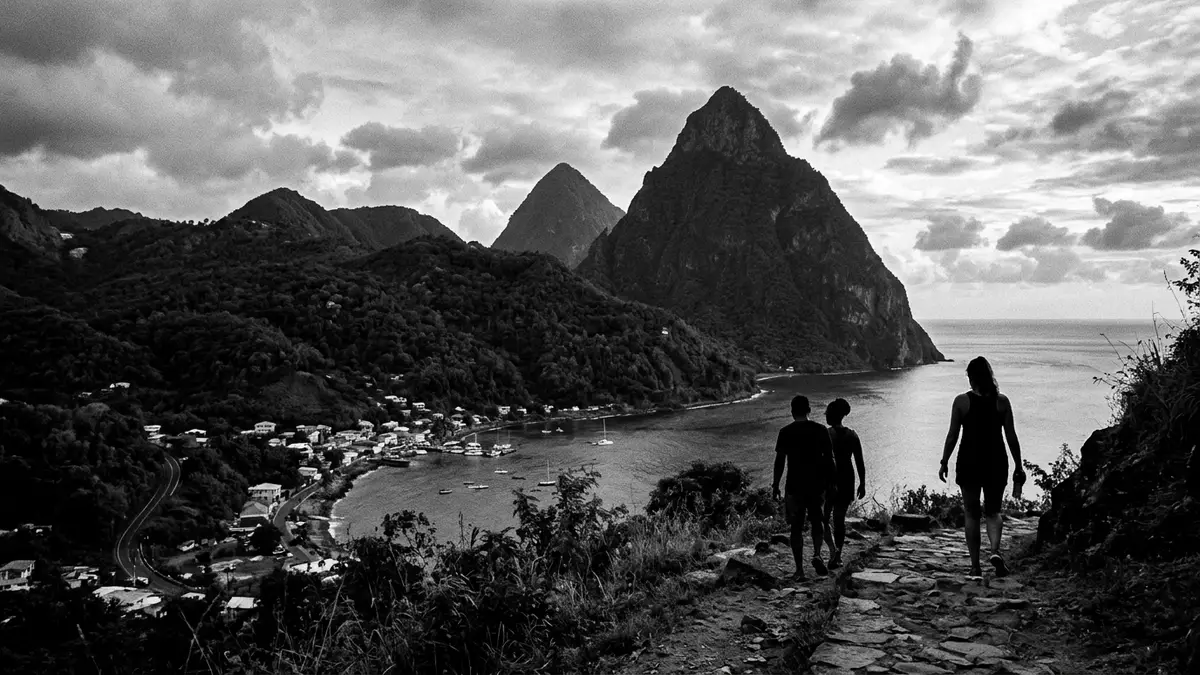
The Pitons near Soufriere in Saint Lucia form a striking pair of volcanic peaks where steep mountains descend directly into the Caribbean Sea. Set within a protected landscape recognised on the UNESCO World Heritage List since 2004, Gros Piton and Petit Piton stand as forested volcanic spires inside the wider Pitons Management Area, a zone that combines mountainous terrain with coastal waters and geothermal features.
Volcanic spires at the edge of the Caribbean
The Pitons rise from the southwest coast of Saint Lucia beside the town of Soufriere, their slopes dropping towards bays and coastal villages on this side of the island. The two peaks, Gros Piton to the south and Petit Piton to the north, stand close together above the sea and are linked by the Piton Mitan ridge, forming a continuous high line that helps define the Pitons Management Area on land.Pitons Management Area The protected area extends over land and coastal waters around Soufriere, and its documented size of 2,909 ha (about 7,190 acres) combines terrestrial slopes with marine habitats.
Gros Piton, the higher of the two peaks, reaches an elevation in the range of 770 to around 798 m (roughly 2,530 to about 2,620 ft), while Petit Piton stands at about 743 m (2,438 ft), giving the pair a near-symmetrical appearance when seen from the sea.Gros Piton and Petit Piton Their steep profiles and forest cover make them prominent landmarks along the coast, with cliffs and ridges descending towards Soufriere Bay and the surrounding shoreline.
A landscape shaped by ancient volcanic activity
The Pitons form part of a larger volcanic system known as the Soufriere Volcanic Centre, a complex that sits within a broad topographic depression often referred to as the Qualibou Depression.Soufriere Volcanic Centre Geological studies describe Gros Piton and Petit Piton as remnants of large dacitic lava domes or volcanic plugs, exposed as steep cores after softer surrounding material eroded away over hundreds of thousands of years.dacitic lava domes
The wider Pitons Management Area brings together this mountainous volcanic terrain with geothermal features and coastal ecosystems. Within the protected zone, hot springs and fumaroles mark continuing geothermal activity, while forested slopes and cliffs give way to reefs and marine habitats offshore.UNESCO nomination dossier The combination of steep volcanic spires, geothermal sites and coastal waters underpins the area’s inscription as a World Heritage Site, recorded in 2004 as a natural property recognised both for geological significance and for outstanding scenic qualities.World Heritage recognition in 2004
Forest, sea and steep slopes around Soufriere
Around Soufriere, the Pitons frame a landscape where steep slopes meet settlement and sea. Gros Piton stands south of Soufriere and Petit Piton rises nearer the middle of Soufriere Bay, giving the town a backdrop of high volcanic rock visible from many vantage points.location near Soufriere Forest vegetation covers much of the peaks, with rocky faces breaking through on the steeper sections and ridges. Below, roads and villages follow the coastline and valleys, and parts of the protected area extend into the sea, where reefs lie offshore.
The Pitons Management Area draws its boundaries around this combination of volcanic slopes and marine environments south of Soufriere and towards Choiseul.extent of the protected area Within it, the two peaks act as the central landmarks in a landscape that also includes coastal bays, geothermal sites in and around the town, and forested hills rising inland. The geomorphology reflects the history of larger stratovolcanoes and gravity-slide structures in this part of Saint Lucia, with the Pitons marking exposed cores on the edge of the Soufriere Volcanic Centre.
Visiting Pitons: what travellers from Western Europe should know
- The Pitons stand on the southwest coast of Saint Lucia near Soufriere, with Gros Piton lying between Soufriere and Choiseul and Petit Piton closer to Soufriere Bay.
- The terrain around the peaks is steep, with forested slopes, rocky sections and significant altitude gain on any ascent, and approaches often include paths with sustained gradients.
- The protected area combines mountainous land with coastal waters, so viewpoints can involve short walks from coastal roads or villages to reach sites where the twin peaks and the Caribbean Sea are visible together.
- Saint Lucia’s official language is English and the currency is the Eastern Caribbean dollar.
- Entry requirements depend on your nationality; UK travellers can check the FCDO travel advice at gov.uk/foreign-travel-advice, Irish travellers the Department of Foreign Affairs at ireland.ie.
Searching for Pitons on social platforms
These links open searches for Pitons on each platform.
Frequently asked questions about Pitons
Where are the Pitons in Saint Lucia?
The Pitons stand on the southwest coast of Saint Lucia near the town of Soufriere, between Soufriere and Choiseul, within the Pitons Management Area.
What should visitors expect when viewing the Pitons?
Visitors encounter steep forested peaks rising directly above bays and coastal villages, with viewpoints that combine high volcanic slopes, the Caribbean Sea and surrounding protected terrain.
What makes the Pitons distinctive among Caribbean landscapes?
The Pitons are distinctive as twin volcanic spires recognised as a UNESCO World Heritage Site, where ancient lava domes, geothermal features and coastal ecosystems meet in a single protected area.


